The short version
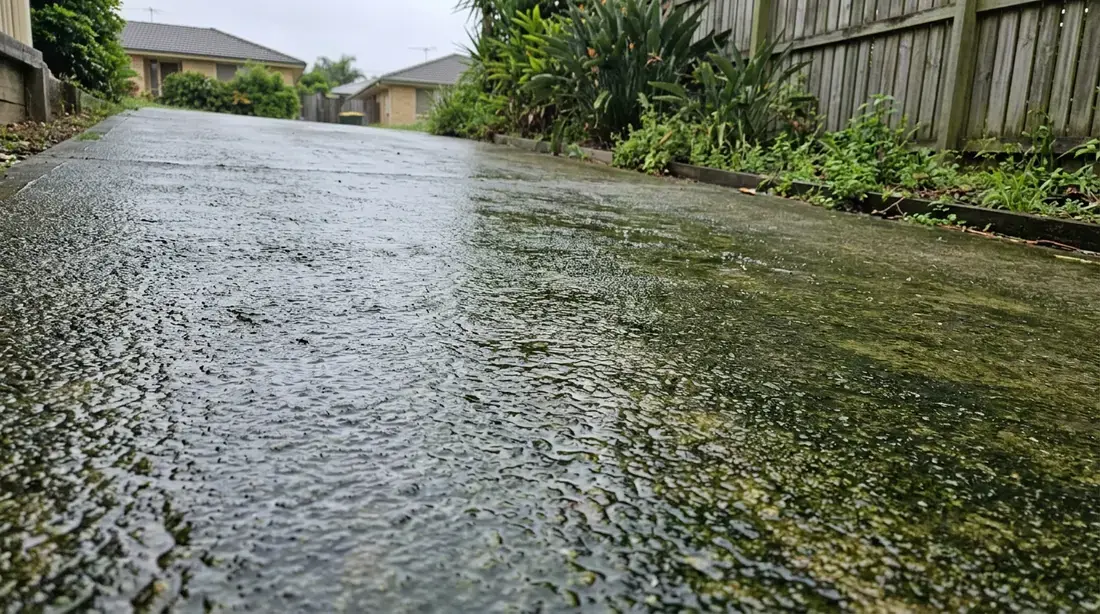
The green on a Brisbane driveway is algae, not dirt, a living film that needs only moisture, shade and a porous surface, all of which a subtropical wet season supplies. It makes concrete genuinely slippery when wet, which is the real reason to deal with it rather than a cosmetic one. Removing it properly means treating it so it dies at the base, because pressure alone shaves off the top layer and the colony grows straight back.
Key takeaways
- The green is algae, a living organism, not accumulated dirt
- It needs moisture, shade and a rough surface, and Brisbane supplies all three
- Wet algae on concrete is slippery, and that is the reason it matters
- The shaded southern side always goes first, and always goes worst
- Pressure alone removes the top layer; a treatment kills it at the base
- A slab under a fig will green up again faster no matter how well it is cleaned
The green is alive
That green film is algae, and it is growing rather than accumulating. It arrives as spores in the air and in rainwater, settles into the pores of the concrete, and multiplies wherever it finds moisture.
This is why it behaves so differently from ordinary dirt. Dirt gets washed away by rain, while algae is fed by it, which is the reason a driveway can look worse after a wet fortnight than before it.
The black speckling that goes with it is usually a different organism doing the same thing, and lichen, the pale crusty rosettes, is a third. All three want the same conditions.
Nov to Mar
Brisbane wet season, peak growing conditions
May to Aug
Months a south-facing slab may see no direct sun
3
Things growth needs: moisture, shade, a porous surface
Brisbane is close to ideal for it
A subtropical climate gives algae almost everything on its list. The wet season from November through March delivers warm, heavy rain, and the humidity that follows keeps a slab damp for hours after the sun is back out.
Warmth is the multiplier. Growth that would be slow through a cold winter elsewhere carries on quietly through a Brisbane one, so the slab never really gets a break.
Storm season adds the rest. Heavy downpours wash red soil off garden beds and across the concrete, and that fine layer of organic-rich silt is exactly what a new colony needs to establish in.
Winter is the one genuine pause. Lower humidity and drier weeks slow everything down, which is why the middle of the year is the sensible window for cleaning and the reason a slab washed in August holds its colour longer.
Why it is always the same side
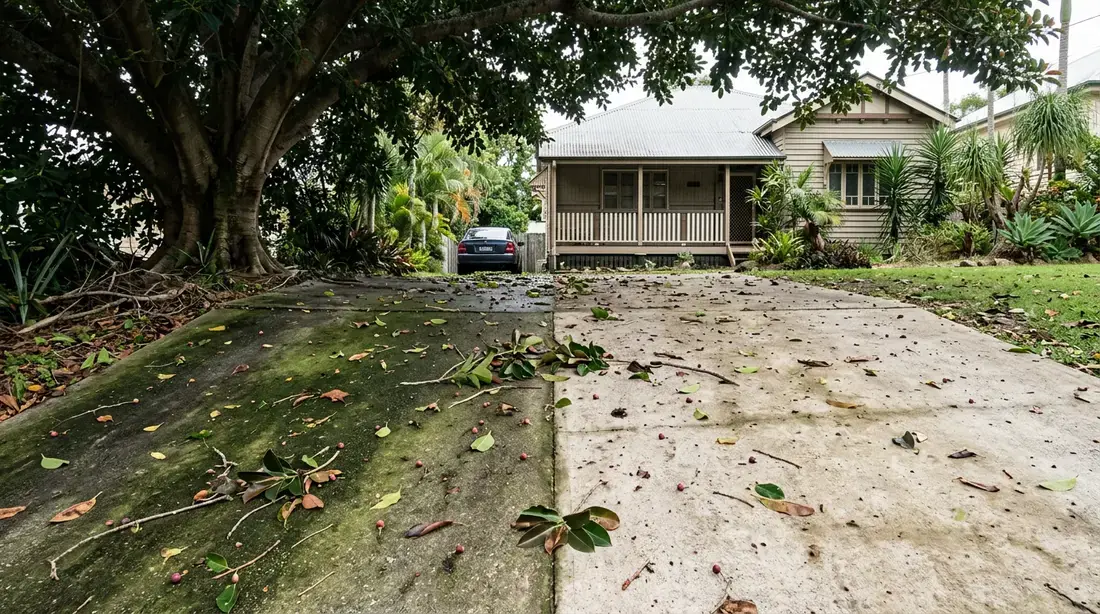
Almost every driveway greens unevenly, and almost every driveway greens on the same side each time. That side is the one that stays wet longest.
In Brisbane it is usually the southern side, or the strip running along the house. Between May and August the sun sits low and to the north, so a slab shaded by a wall, a fence or a carport may not get direct sun for months.
- The southern boundary, and anywhere the house itself casts a permanent shadow
- Under mature figs, jacarandas, poincianas and mangoes, which shade and drop at the same time
- Low spots and poor falls where water sits for a day after every storm
- The strip beside a garden bed that is watered regularly
- Below a downpipe that discharges across the concrete instead of into a drain
- Behind a gate or in a carport, where air movement is limited and the slab dries slowly
Trees are the compounding factor. They shade the slab, they drop leaf matter that holds moisture against it, and figs and jacarandas add tannin that stains the concrete a warm brown people usually read as more dirt.
Bayside driveways have an extra problem
Closer to the water, Wynnum, Manly, Lota, Thorneside, Birkdale, there is salt in the air, and it settles on everything. On a driveway it forms a fine film that holds dust and moisture against the surface.
That film does not cause growth on its own, but it gives it a head start. Bayside slabs commonly need attention sooner than equivalent driveways a few suburbs inland, in the same amount of shade.
Sand and grit tracked in from the foreshore does its own quiet damage over the years, working into the surface of pavers and aggregate. It is a slow process and worth knowing about if you live within a few streets of the water.
Slippery is the part that matters
A green driveway looks neglected, which is what most people call about. The reason to act on it is that wet algae on concrete is genuinely slippery.
The film is soft and holds water, so a shoe on it slides over the top rather than gripping the concrete beneath. On a sloped driveway on a wet winter morning that is a real hazard, and it is worst exactly where the growth is heaviest.
The test is underfoot, not in the mirror
If the slab feels slick when it is damp, it needs cleaning regardless of how it looks from the street. That applies double where the driveway is on a slope or where children and older visitors use it.
Strata and commercial sites carry this as a standing obligation rather than a preference, which is why shared driveways, ramps and car parks tend to be cleaned on a schedule.
Why blasting it off does not last
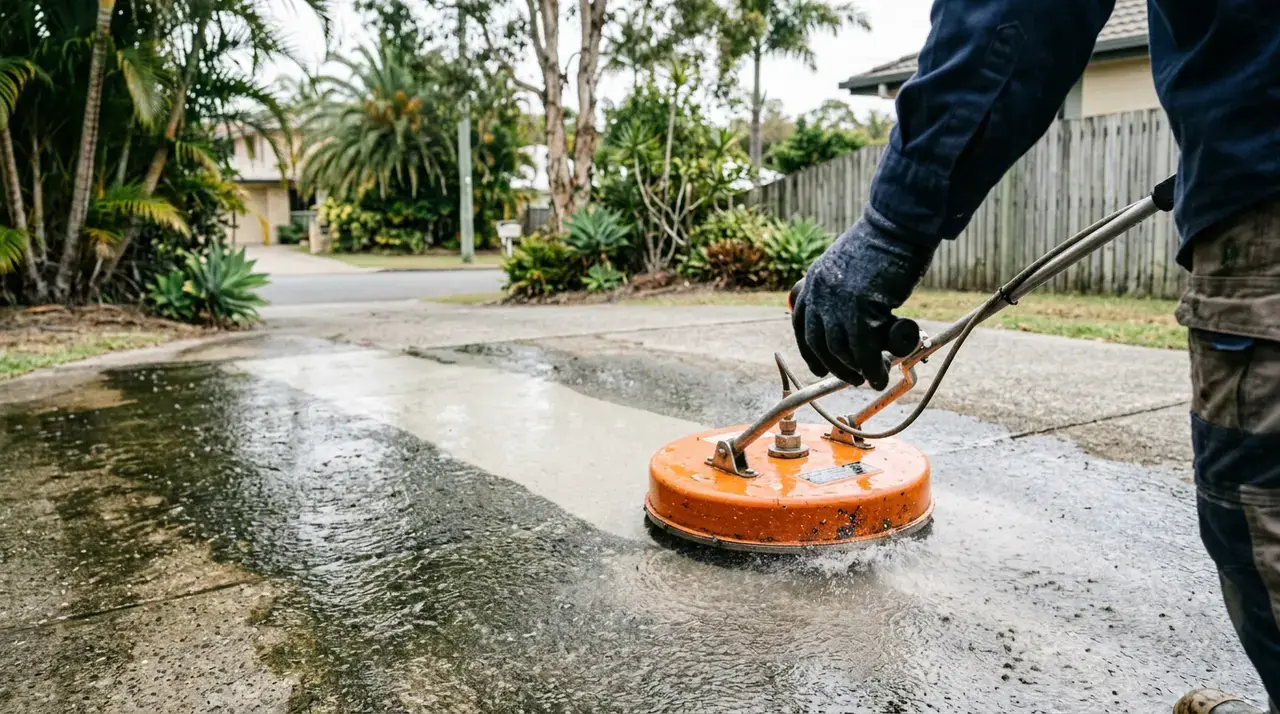
You can remove visible algae with pressure alone. What you have done is shave off the top of a colony whose base is still down in the pores of the concrete, and it regrows from there.
That is why a driveway cleaned with force and nothing else looks excellent for a month and disappointing by the end of the season. Nothing killed the growth; it was just removed from view.
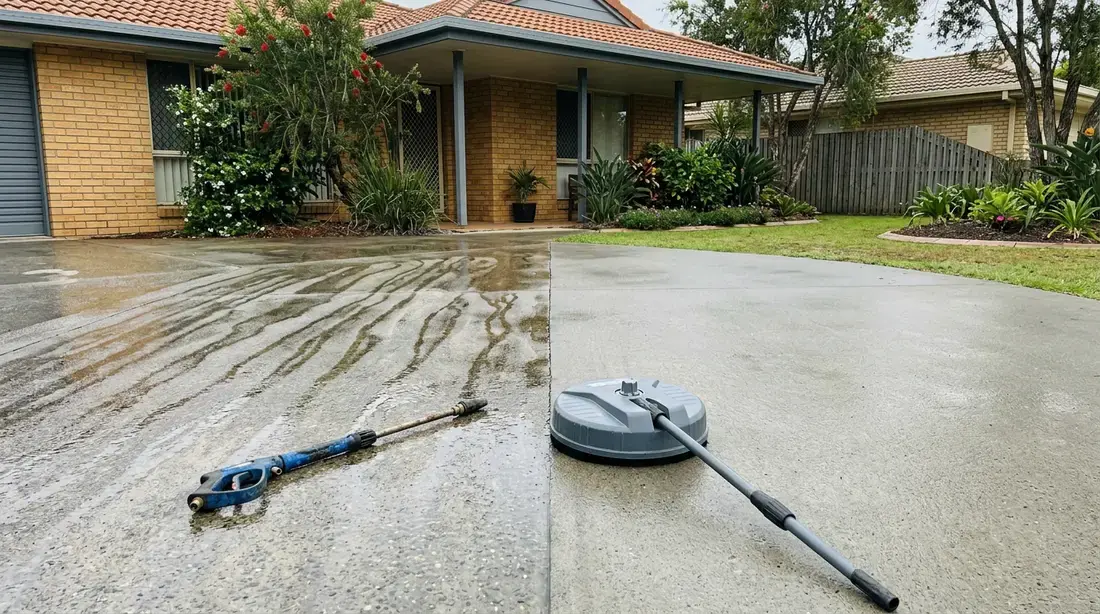
A pre-treatment changes that. Applying a cleaning solution and letting it dwell for ten to fifteen minutes kills the growth at its base, so the wash that follows takes away dead material rather than trimming a living colony.
Treated slabs stay clean noticeably longer than slabs that were only blasted, and that difference costs nothing but the dwell time.
The same logic sets the pressure. On exposed aggregate and pavers the chemistry has to carry most of the load anyway, because the pressure that would strip a colony off plain concrete will strip the paste from between the stones.
What actually slows the regrowth
You cannot make a Brisbane driveway immune. You can change how long the surface stays wet, and that is the whole game.
- 01
Let more light in
Lifting the lower branches over the slab is the highest-value change available. Even a modest increase in morning sun shortens the damp window every single day.
- 02
Keep the leaf litter off
A wet leaf mat is a nursery. Sweeping through autumn removes the material a new colony would otherwise establish in over the wet season.
- 03
Fix where the water goes
Check downpipes, sprinkler throw and garden beds washing soil across the concrete. A slab that gets a daily soaking from an irrigation head will always green there first.
- 04
Improve the drying, not just the drainage
Air movement matters as much as fall. Opening up a fence line or clearing overgrowth along an edge helps a slab dry rather than sit damp.
- 05
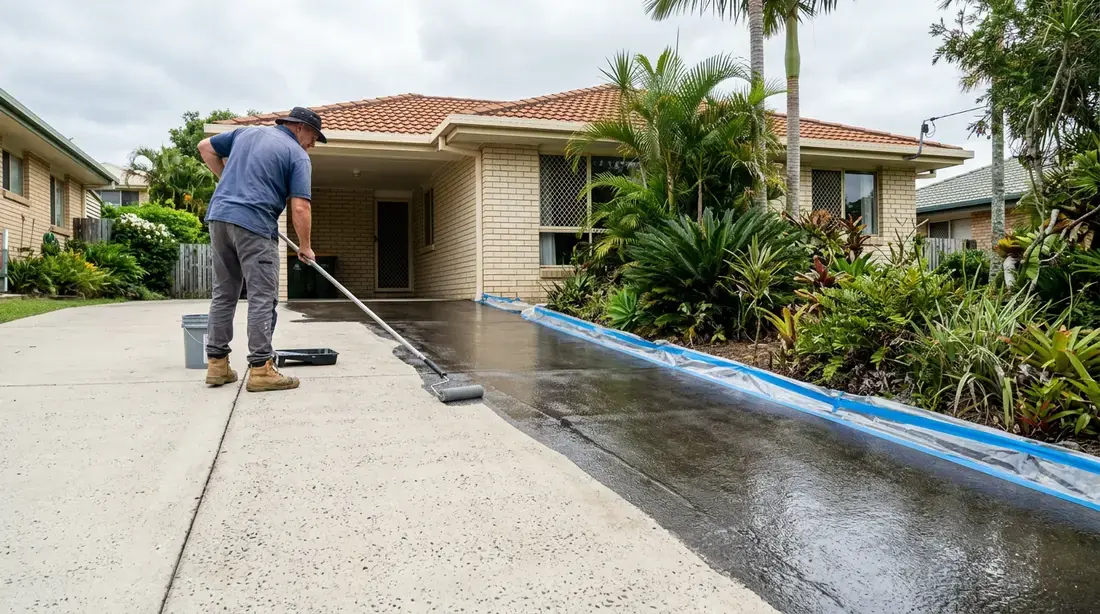
Consider sealing a porous slab
Closed pores hold less moisture and give algae less to grip. It is the strongest option for a shaded driveway under a tree nobody intends to remove.
Some driveways will always come back faster
A south-facing slab under a mature fig will green up again sooner than a north-facing one in open sun, no matter how well either is cleaned. That is a scheduling fact rather than a failure of the clean.