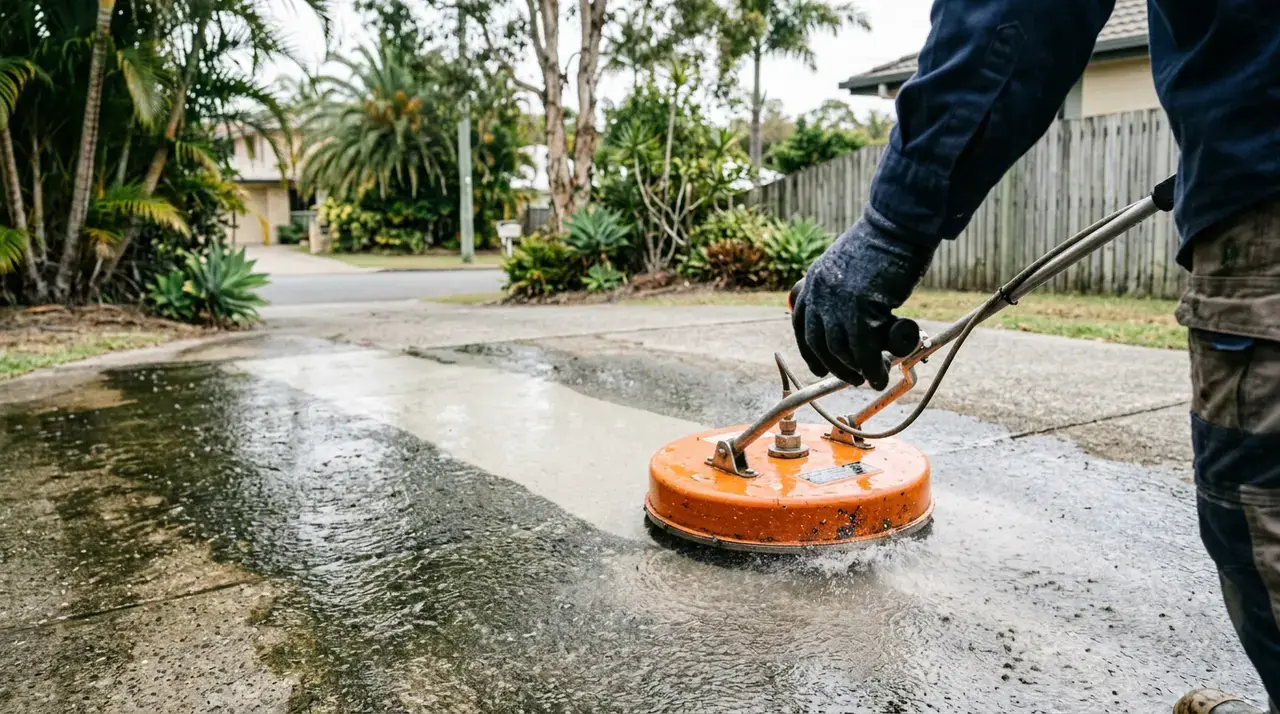
Driveway cleaning service
Driveway Pressure Washing in Brisbane
Concrete, aggregate and paved driveways washed back to an even colour, with the pressure set to the surface in front of us.
What it is
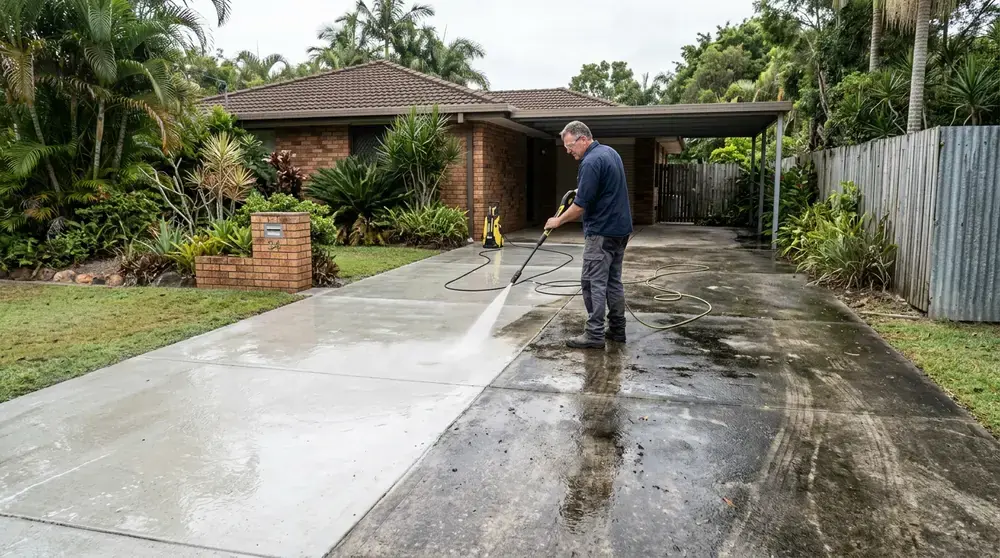
Driveway pressure washing, done to suit the slab
A driveway is the biggest slab of hard surface most Brisbane homes own, and the one nobody looks at until it has gone grey-green.
Pressure washing puts it back to the colour it was under the build-up. We set the machine to your slab rather than running every job at one pressure.
We work about 30km around Wynnum West. Most residential driveways are done in a single visit.
Every clean includes
- Surface assessed and the pressure set before we start
- Oil, rust and organic staining pre-treated separately
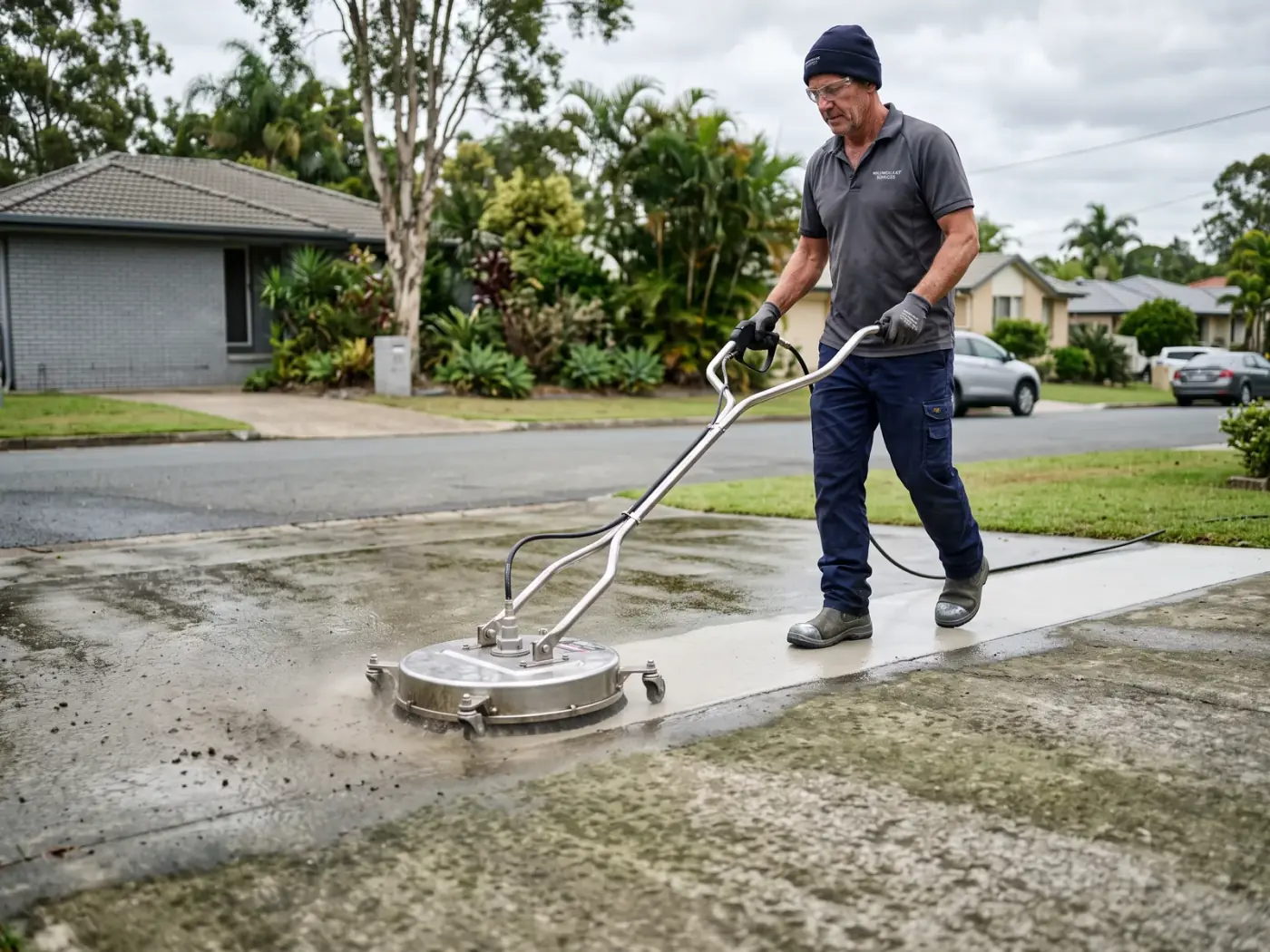
- Rotary surface cleaner across the open slab for an even finish
- Wand work into edges, joints and corners by hand
- Full rinse-down so lifted grime leaves with the water
- Paths, kerb and garden edge washed off before we go
Step by step
What happens on the day
- 01
Walk the slab
We look at the surface type, the finish, any cracking, spalling or previous sealing, and note where the stains are and what caused them.
- 02
Set up and protect
Cars moved off, garden beds and downpipe outlets checked, and anything that should not get wet covered or moved clear.
- 03
Pre-treat
A cleaning solution goes onto the organic growth and is left to dwell. On heavy lichen this step gets repeated rather than rushed.
- 04
Spot-treat the stains
Oil and grease get a degreaser worked in with a brush. Rust and tannin marks get their own treatment, because the chemistry that lifts them is different.
- 05
Surface clean
The rotary head runs in overlapping passes at the pressure set for that slab, followed by the wand along edges, steps and borders.
- 06
Rinse and check
The whole area is rinsed so nothing dries back as a residue line, run-off is directed away from garden beds, and we walk it with you before we pack up.
Why it happens
Why Brisbane driveways go dark so quickly
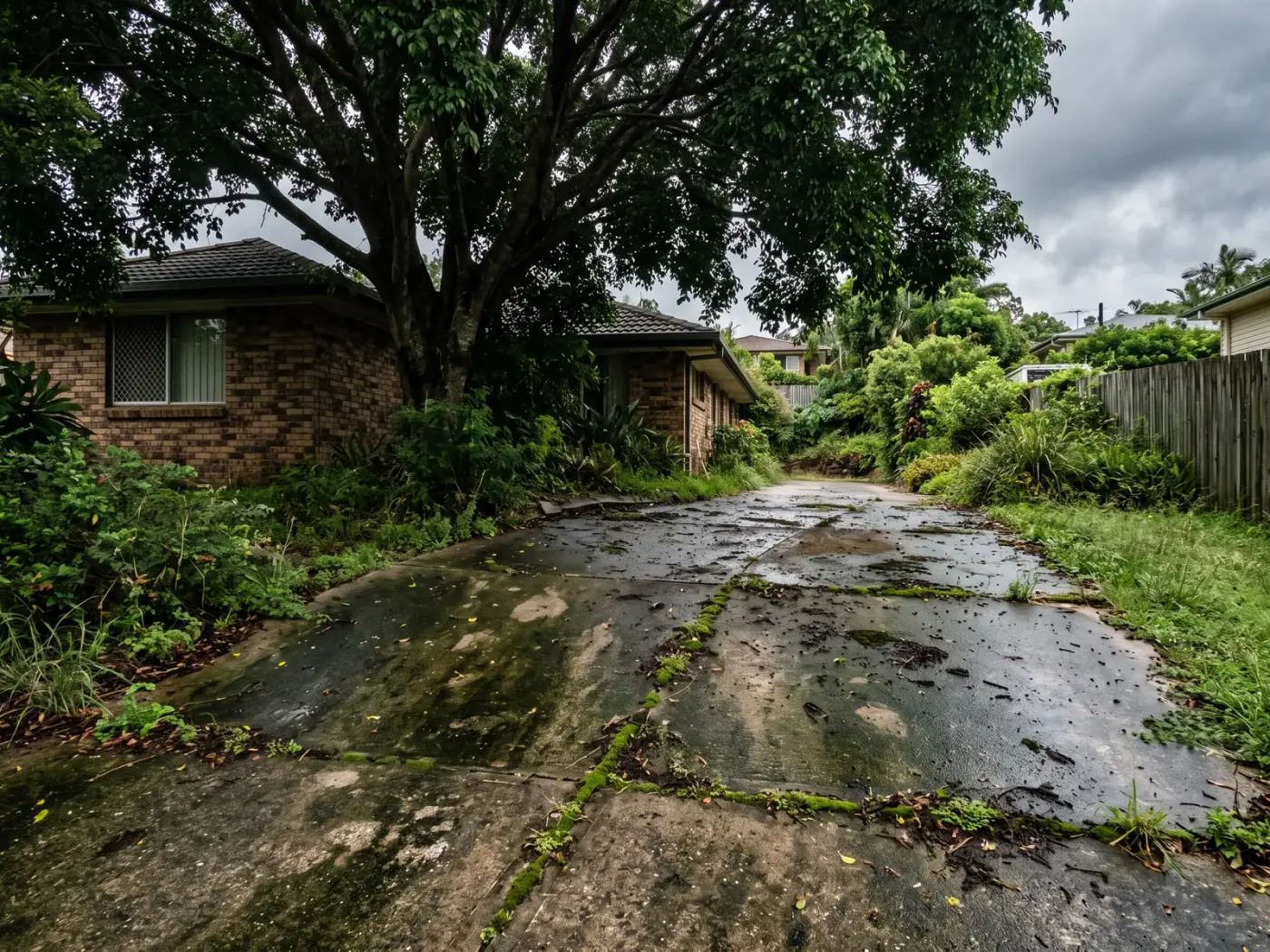
Nearly all the darkening on a Brisbane driveway is organic. Algae, lichen and mould colonise the pores in the concrete and hold moisture, which makes the next colony easier to establish.
Shade does the rest. A driveway on the southern side of a house, or one under a mature tree, may not see direct sun between May and August, so the surface stays damp far longer than it looks.
That is why a slab left alone for five years looks disproportionately worse than one washed each year. It is not dirt building up, it is something growing.
Don't leave it too long
Signs your driveway is due
- The surface has gone grey-green rather than grey
- It is slippery underfoot after rain
- Dark patches sit where the shade falls
- Tyre marks and oil have stopped rinsing off
- Moss or weed growth in the joints and edges
- It has simply been more than twelve months
Matched to your surface
Choosing the pressure and the tool
Surface
Typical pressure
Main tool
Sound plain concrete
Typical pressure
2,500-3,000 psi
Main tool
Rotary surface cleaner
Exposed aggregate
Typical pressure
1,500-2,000 psi
Main tool
Surface cleaner, raised pass
Clay and concrete pavers
Typical pressure
1,500-2,200 psi
Main tool
Surface cleaner, then wand on joints
Older or spalling concrete
Typical pressure
Under 1,500 psi
Main tool
Wide fan tip, treatment led
Stencilled or coated concrete
Typical pressure
Low pressure only
Main tool
Treatment and rinse
Starting points. The actual setting is decided on site after we test a small area.
The machine matters less than the tip and the technique. A zero-degree tip at full pressure will clean concrete and leave permanent stripes in it, which is the most common piece of self-inflicted damage on a suburban slab.
For flat work we use a rotary surface cleaner, an enclosed head with two spinning jets that passes the same energy over every square centimetre. It is what keeps a large slab even instead of tiger-striped. The wand comes out for edges, steps, garden borders and the corners the head cannot reach.
Where the growth is heavy, pressure alone is the slow way to do it. We pre-treat, let the solution dwell for ten to fifteen minutes so it kills the growth at the base rather than shaving off the top, then wash. Treated slabs stay clean noticeably longer than slabs that were only blasted.
Free quote
Get a quote for driveway pressure washing
Tell us the surface, roughly how big it is and what has stained it. We'll match the method and give you a clear price before anything is switched on.
- 01
You tell us the surface
Concrete, aggregate or pavers, roughly how big, and what has stained it. A photo helps but is not needed.
- 02
We come back with a price
For the area and the work involved, including anything that needs pre-treating. Nothing starts before you have seen it.
- 03
We book a time that suits
Most driveways are a single visit. You do not need to be home, as long as we can reach a tap and the cars are moved.
Would you rather just talk it through?
(07) 2102 12287:30am - 4:00pm weekdays, 7:30am - 12:00pm weekends.
The full detail, method, surfaces, run-off and aftercare5 sections, open if you want the long version
What driveway pressure washing actually removes
Nearly all of the darkening on a Brisbane driveway is organic. Algae, lichen and mould colonise the pores in the concrete and hold moisture, which makes the next colony easier to establish. That is why a slab left alone for five years looks disproportionately worse than one washed each year.
The rest is traffic and tree. Tyre rubber, brake dust, engine drips and the black scuff of a wheel turned on the spot sit on top of the organic layer. Overhanging figs, jacarandas and poincianas add leaf tannin, which stains a warm brown that most people mistake for dirt.
- Green and black algae film, heaviest on the shaded southern side of the house
- Lichen, the pale crusty rosettes that grip into the surface and need dwell time rather than force
- Tyre rubber and brake dust in the wheel tracks and at the turning point near the garage
- Oil, coolant and hydraulic drips, usually in a line where the car sits
- Leaf tannin from figs, jacarandas, poincianas and mango trees
- Red soil washed down off garden beds and driveway edges after a storm
- Efflorescence, the chalky white bloom that pushes up out of concrete and pavers
Grey is not always dirt
Concrete lightens as the cement paste wears and the sand beneath comes through. A clean takes off everything sitting on the surface, but it cannot put back paste that has already worn away.
Getting set up before the machine starts
Most of what slows a driveway job down has nothing to do with the cleaning itself.
It is the tap that will not fill the machine, the padlocked gate, or the car nobody moved.
Water and power
We run off your outside tap and a standard power point.
A tap with poor flow will not keep a pressure washer fed. If yours dribbles rather than runs, tell us when you book and we will bring a buffer tank instead.
Getting to the slab
Gates, side access and a steep drive all change how we set up. Hoses have to reach from the tap to the far end, and on a sloped block we work top down so dirty water never runs back across a finished section.
Cars, bins and the street
Vehicles need to be off the slab, and ideally off the verge in front of it. Anything stored along the edge, pot plants, bikes, a trailer, is easier to shift before we arrive than around us.
The two-minute call that saves an hour
Mention a locked gate, a shared driveway, a dead tap or a car that cannot be moved. Every one is easy to plan around and awkward to discover on the morning.
Where the water and the run-off end up
A driveway wash puts a lot of water on the ground, and most driveways fall towards something, a garden bed, a fence line, or the street.
Garden beds and lawn
Cleaning solution is heavily diluted by the time it leaves the surface cleaner, but we still keep it off anything precious.
Beds along the edge are rinsed with clean water first so the soil is already wet and takes up less. Run-off is then pushed towards a path or the kerb rather than into the roots of a hedge.
Your neighbours' side
On a shared or boundary driveway the water goes somewhere that is not yours.
We work the fall so it does not run under a neighbour's gate, across their paving or into an open garage. Any overspray on their fence or wall gets rinsed off before we leave.
Tell us where the drain is
If you know your driveway feeds a pit that backs up, or drains towards a pool, say so at the start. Directing run-off away from it takes a hose position, not a change of plan.
Debris is the other half of it. The grit, leaf matter and moss that comes off the slab gets swept up and taken away rather than flushed into the stormwater grate.
What driveway pressure washing will not fix
Most driveways come up better than the owner expected. It is still worth saying plainly what a wash cannot do, because the gap between a good result and a perfect one is usually chemistry and age rather than effort.
- Oil that soaked in years ago will lighten, sometimes a lot, but a shadow often remains, the stain is inside the concrete, not on it
- Tyre scuff burned into a soft slab at a turning point can be embedded in the surface itself
- Spalling, crazing and hairline cracks become visible again once the grime is gone; the clean reveals them rather than causing them
- Concrete faded by years of Queensland sun will not return to its original colour, because the change is in the material
- A failing old sealer looks blotchy under a clean and needs stripping rather than washing
We would rather tell you a stain will lighten than promise it will disappear and hand back a driveway that does not match the description.
If we can see before we start that a particular mark is unlikely to come out fully, we say so at the quote. That is a better conversation to have then than once the gear is packed away.
Keeping the slab clean between washes
How long a clean lasts depends mostly on light and water. A north-facing driveway in full sun can look good for two or three years. The same slab under a fig on the southern boundary can green up inside a single wet season.
- Lift overhanging branches where you can, even a small increase in morning sun slows regrowth
- Keep leaf litter swept off, because a wet leaf mat is where growth starts
- Check that downpipes and garden beds are not sending soil or constant water across the slab
- Rinse oil drips away early; fresh oil comes up far more easily than oil that has sat through a summer
- Consider sealing if the slab is porous and you are tired of the cycle
Book before the wet season, not after
A slab cleaned in September goes into the heavy rain months with nothing established on it. Cleaning in March means you have already carried the growth through its best growing conditions.
More we do
Related driveway cleaning services
Concrete Driveway Cleaning
Broom-finished, trowelled and coloured concrete cleaned to an even colour, with oil, rust and tannin treated separately.
Read moreExposed Aggregate Cleaning
Aggregate cleaned at a pressure the topping can take, so the stone comes back without the paste holding it being stripped out.
Read morePaver Driveway Cleaning
Brick, clay and concrete pavers cleaned face and joint, with weeds pulled by hand and fresh jointing sand swept back in.
Read more


Where we work
Driveway cleaning right across Brisbane
FAQ
Driveway Pressure Washing FAQs
The questions we get asked most about driveway pressure washing in Brisbane.
1How long does driveway pressure washing take?
Most single and double Brisbane driveways are finished in one visit, generally two to four hours depending on size, surface and how heavy the build-up is. Pre-treatment dwell time and stubborn oil stains add to that. We give you an expected time when we quote.
2Will pressure washing damage my concrete driveway?
Not when the pressure is matched to the slab. Damage happens when a narrow tip at full pressure is held in one place, which etches lines into the surface. We use a rotary surface cleaner at a setting chosen after testing a small out-of-the-way area first.
3Do I need to be home while you clean?
No, as long as we can reach the driveway, an outside tap and a power point, and any cars are moved off the slab. Plenty of clients leave us to it and come home to a finished job. We will call you if we find something you should know about.
4How much water does a driveway clean use?
A typical residential driveway uses a few hundred litres, less than a garden hose run for the same time, because a pressure washer delivers force rather than volume. We connect to your outside tap and direct run-off away from garden beds and drains.
5How often should a Brisbane driveway be pressure washed?
Every one to two years suits most Brisbane homes, and shaded or tree-covered driveways often need it annually. Full-sun slabs with nothing overhanging can stretch to three years. The wet season is the main driver, so timing the clean before it makes each wash last longer.
6Can you clean the paths and patio at the same time?
Yes. Paths, entries, steps, patios and pool surrounds are the same work with the same equipment, and doing them on one visit is more efficient than separate trips. Tell us the full area when you call and we will quote the lot together.
7What is the difference between pressure washing and soft washing a driveway?
Pressure washing uses mechanical force. Soft washing uses a cleaning solution at low pressure and lets the chemistry do the work. Most driveways get both, a pre-treatment that kills organic growth, then a controlled wash to remove it. Delicate or coated surfaces get the treatment side only.
Still have a question?
Give us a call and we'll give you a straight answer, no obligation.
Get a free driveway quote
Tell us the surface, roughly how big it is and what has stained it. We'll match the method and give you a clear price before anything is switched on.