Driveway cleaning service
Exposed Aggregate Driveway Cleaning
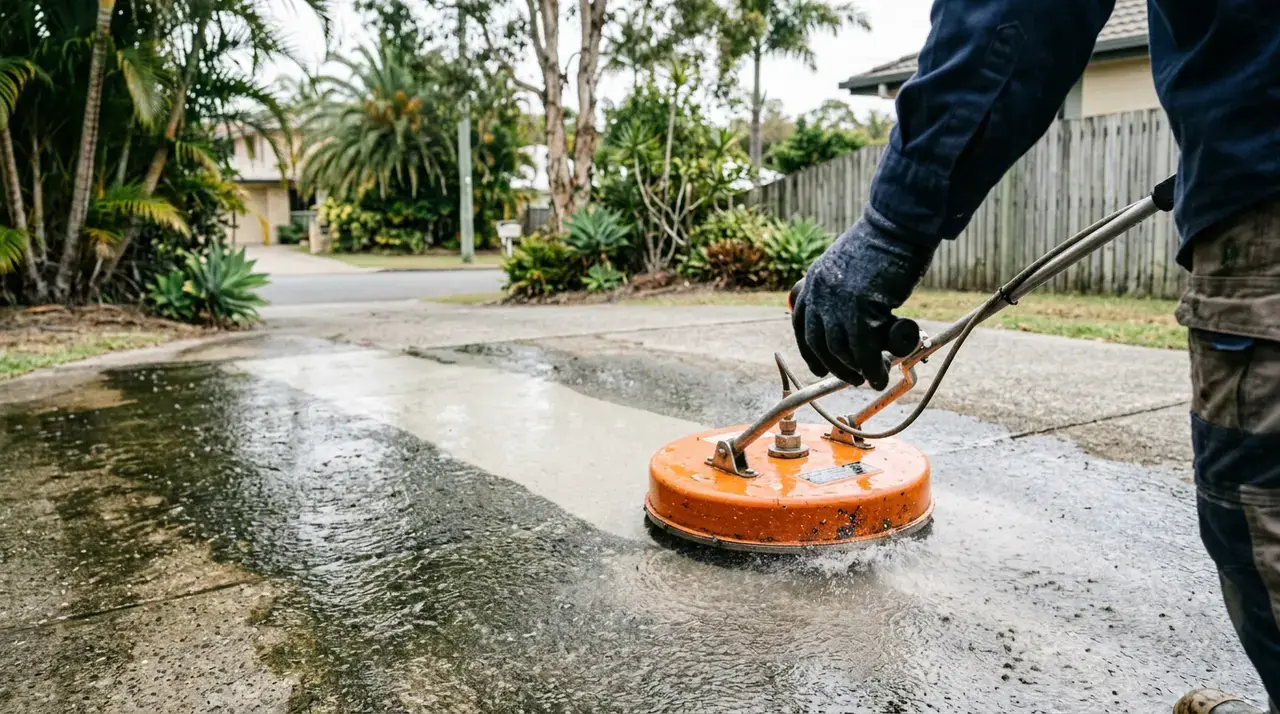
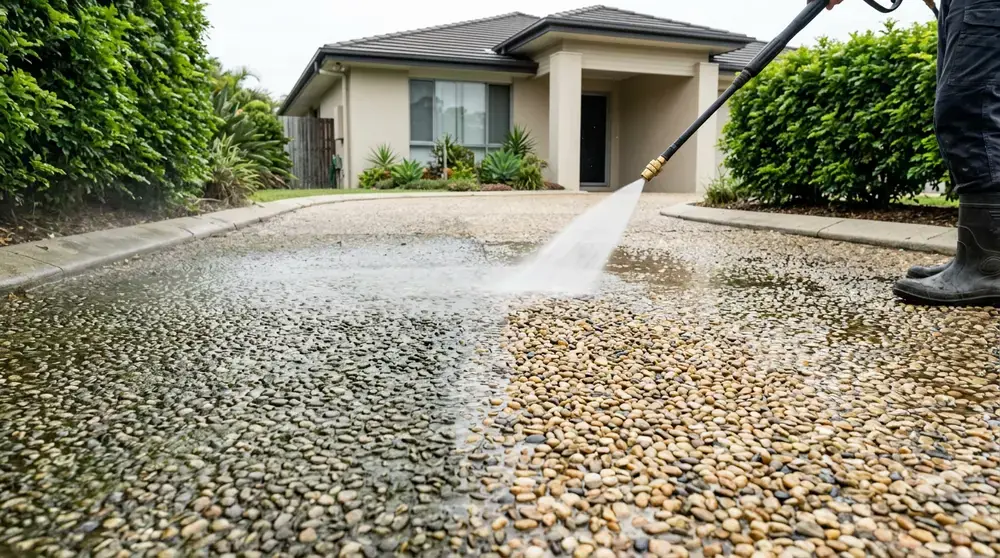
Aggregate cleaned at a pressure the topping can take, so the stone comes back without the paste holding it being stripped out.
What it is
Lower pressure, longer dwell, pebbles left where they were laid
Exposed aggregate has been the default for new Brisbane driveways for twenty years. It looks good, grips well in the wet, and is the surface most often wrecked by an over-enthusiastic wash.
The stones are held by a thin layer of cement paste. Blast that out and the pebbles start letting go.
So it gets lower pressure, longer dwell and careful overlapping passes instead.
Every clean includes
- Pressure set well below what a plain slab would take
- Pre-treatment given time to work before any water
- Overlapping passes so no single spot takes a concentrated hit
- Growth lifted out of the low points between stones
- Loose or already-lifting stones flagged to you, not washed away
- Rinse down and full clean-up of displaced grit
Step by step
On the day
- 01
Check the topping
We look for stones already loose or missing, previous sealer, and any patch where the paste has thinned. That decides the pressure before anything is switched on.
- 02
Protect and prepare
Garden beds, paintwork and adjacent timber are checked, and run-off routes noted so treated water goes where it should.
- 03
Treat and dwell
The whole surface is pre-treated and kept wet through the dwell, so growth down in the gaps between stones is dealt with, not just the growth on top.
- 04
Low-pressure surface clean
Overlapping passes with the head raised, at a pressure set from the test area rather than a default setting.
- 05
Detail the edges
Wand work along borders, steps and the garage lip with a wide fan, plus any spot treatments for oil or tannin.
- 06
Rinse and check for loose stone
A full rinse, then a walk-over to confirm nothing has lifted and that the colour is even right across the slab.
Why it happens
Why aggregate is a different job
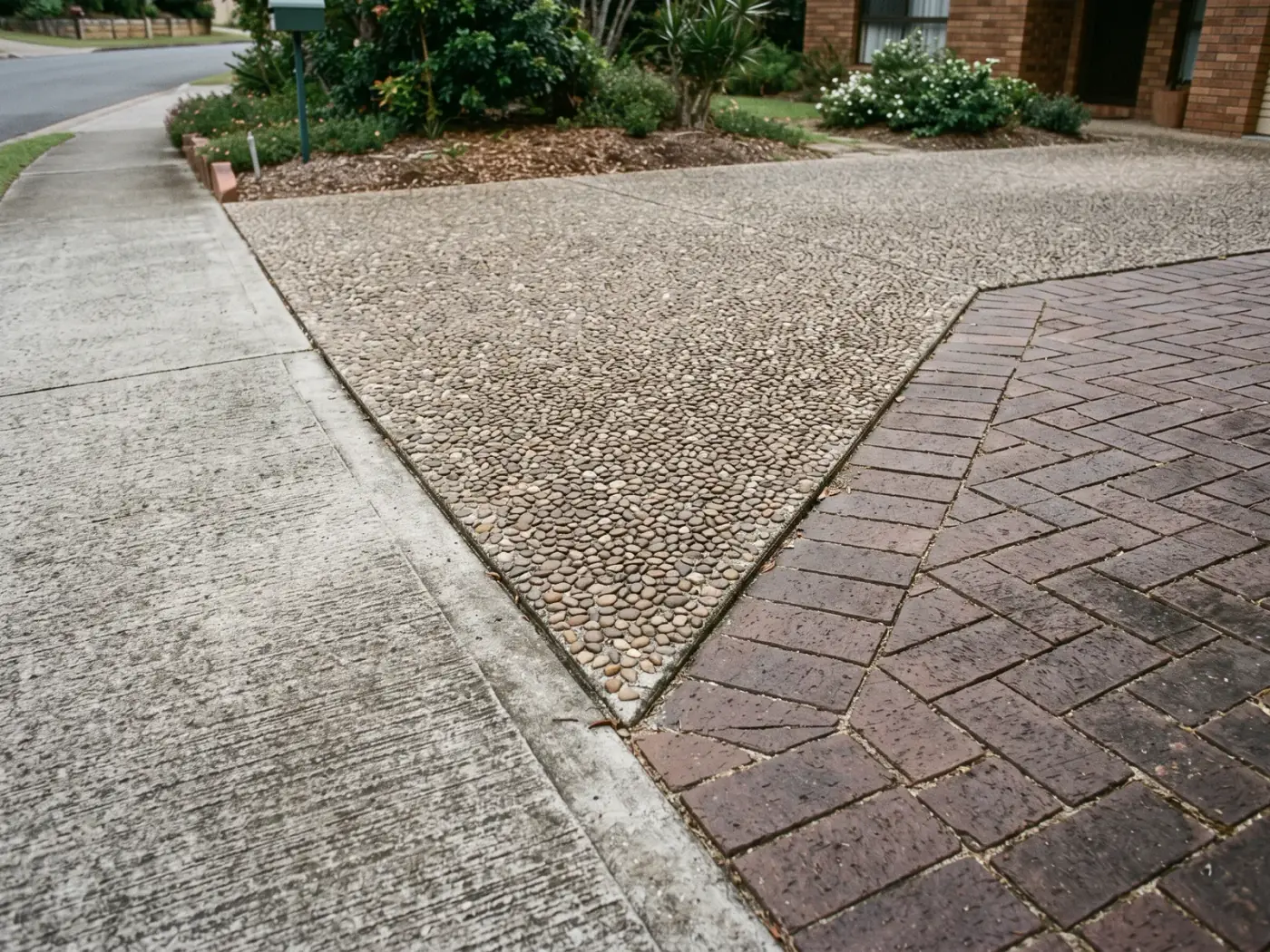
On a plain slab the surface you are cleaning is the surface. On aggregate the surface is thousands of stones sitting in a matrix a few millimetres thick.
Too much pressure in one spot washes that matrix out. The stone above it has nothing left holding it, and the driveway starts shedding pebbles into the gutter.
That is a repair, not a re-clean. It is the reason we would rather do two gentle passes than one hard one.
Don't leave it too long
What we look for on exposed aggregate
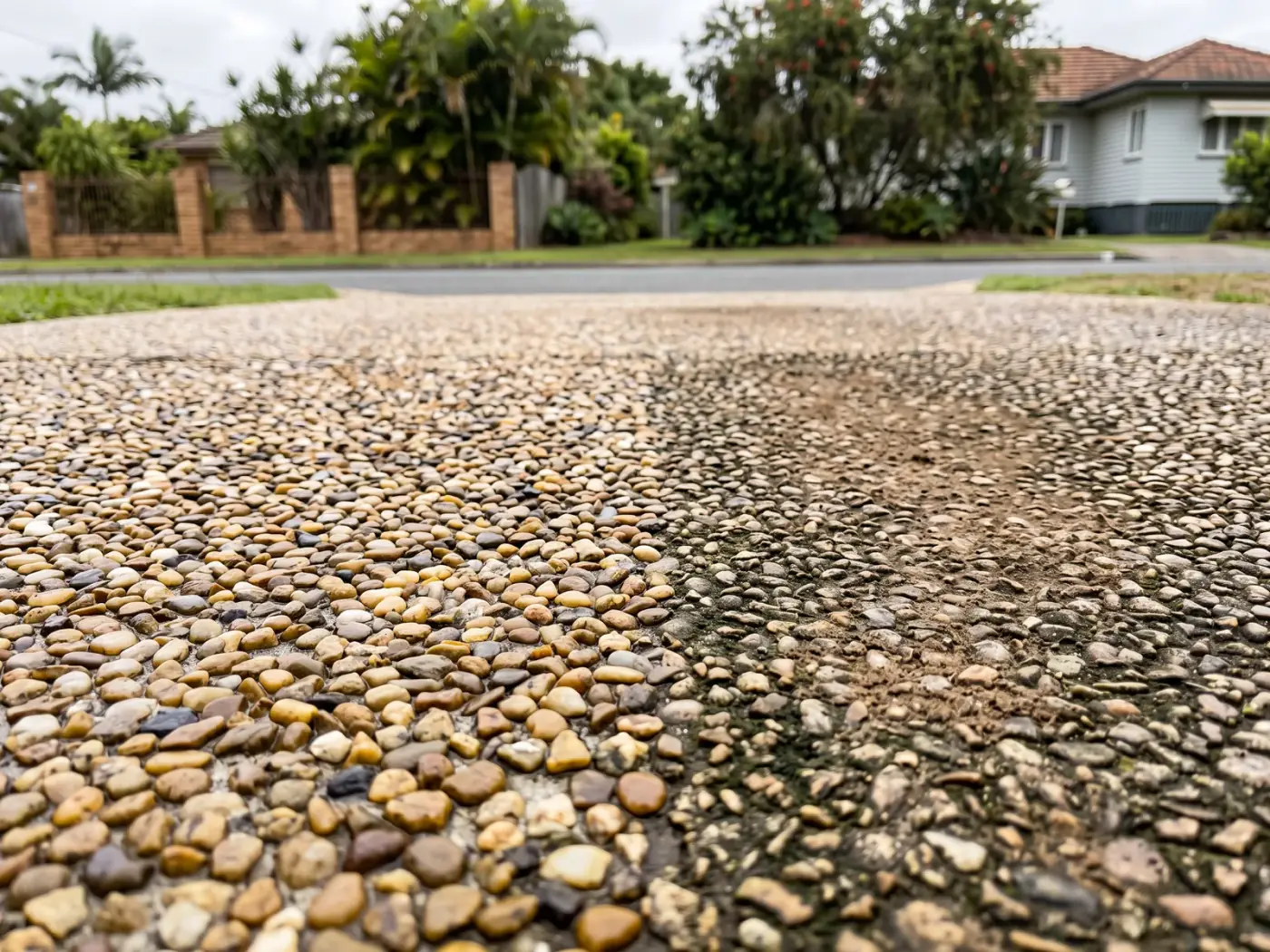
- Algae and mould in the low points before the stones discolour
- Fine red soil packed into the gaps after a storm
- Leaf tannin staining the pale stone
- Moss through the shaded and sloped sections
- Tyre rubber across the high points in the wheel tracks
- Loose stones, or bare patches where stones have already gone
Matched to your surface
A hire unit against a surface cleaner
Hire unit and wand
Rotary surface cleaner
Where the force lands
Hire unit and wand
One narrow line, at whatever distance your arm holds
Rotary surface cleaner
Spread evenly across the width of the head
What the operator controls
Hire unit and wand
Pressure, angle and speed, all by feel
Rotary surface cleaner
Pressure only, the head sets height and spacing
Usual look afterwards
Hire unit and wand
Clean tracks with lighter and darker banding
Rotary surface cleaner
Even colour right across the slab
Risk to the topping
Hire unit and wand
Paste cut out wherever the tip lingered
Rotary surface cleaner
Low, provided the pressure is set first
Time on an average drive
Hire unit and wand
Often more than one session
Rotary surface cleaner
Part of a single visit
The wand still has a job on aggregate, edges, steps and joints. It is the open middle where it causes trouble.
Most people who ring us about aggregate have already had a go themselves, or watched a neighbour have one.
The gap is not effort. It is what the tool on the end of the hose does to the paste holding the stones in place.
None of that makes a hire unit useless.
It makes it the wrong tool for the open stretches of an aggregate slab, which is exactly where the damage shows and where it cannot be undone.
Free quote
Get a quote for exposed aggregate cleaning
Tell us the surface, roughly how big it is and what has stained it. We'll match the method and give you a clear price before anything is switched on.
- 01
You tell us the surface
Concrete, aggregate or pavers, roughly how big, and what has stained it. A photo helps but is not needed.
- 02
We come back with a price
For the area and the work involved, including anything that needs pre-treating. Nothing starts before you have seen it.
- 03
We book a time that suits
Most driveways are a single visit. You do not need to be home, as long as we can reach a tap and the cars are moved.
Would you rather just talk it through?
(07) 2102 12287:30am - 4:00pm weekdays, 7:30am - 12:00pm weekends.
The full detail, method, surfaces, run-off and aftercare6 sections, open if you want the long version
Why exposed aggregate driveway cleaning is a different job
An aggregate slab is poured like any other, then the top layer of paste is washed or etched away to reveal the stone underneath. What holds the whole surface together afterwards is a thin skin of cement between the pebbles.
That skin is the entire margin for error. At the pressure that suits plain concrete, an aggregate slab starts shedding stone, and once a few pebbles are out the ones around them loosen. It shows up as a pitted patch that no amount of later cleaning hides.
So we drop the pressure and raise the head. The surface cleaner runs slightly further off the slab, the pass is slower, and the pre-treatment carries more of the load.
The hire-machine trap
Damaged aggregate is most often the result of a weekend hire unit fitted with a turbo or zero-degree tip. Those tips are excellent on a concrete path and destructive on an aggregate driveway.
Chemistry first, pressure second
On a plain slab we can make up for a weak pre-treatment with more pressure. On aggregate that option does not exist, so the treatment step has to be right the first time.
Pre-treatment and dwell
A cleaning solution is applied across the whole surface and left long enough to kill the growth at its base. On a hot Brisbane afternoon it can dry before it has finished working, so on warm days we mist the slab to keep it wet through the dwell.
The wash
The rotary head runs at reduced pressure with the skirt raised slightly, in overlapping passes. Because the pressure is lower the pass rate is slower, even coverage matters more here than on any other surface we clean.
Edges and joints
Wand work along the edges is done with a wide fan tip held further back than on plain concrete. Expansion joints are cleaned carefully so the filler is not cut out of them.
Slope, water supply and getting the gear in
Aggregate turns up on newer blocks, and newer blocks in Brisbane are often steep, narrow or both. The practical side of the job matters more here than it does on a flat suburban slab.
Working a slope
On a sloped drive we start at the top and work down, so treated water never runs back across a section already finished.
It also means the run-off travels a long way. We watch where it lands, a garden bed at the bottom, a neighbour's crossover, or the kerb.
Tap flow, not tap pressure
A pressure washer needs volume from the tap more than it needs pressure at the tap.
If your outside tap takes its time filling a nine litre bucket, mention it when you book. We will bring a tank rather than run the machine hungry.
Room to work
Cars off the slab, side gates unlocked, and a clear run for the hose from the tap to the far corner. On a unit or a duplex we also need to know whether the drive is shared and who else uses it during the day.
Sealed aggregate and cloudy sealer
A lot of Brisbane aggregate was sealed when it was poured, and a solvent-based sealer has a working life of a few years in this climate. When it starts to fail it goes cloudy, patchy or milky white, particularly where water sits.
Cleaning does not fix a failed sealer. The haze is inside the coating, so washing the surface leaves a clean slab with the same cloudy film on it. That is a stripping job, and it is worth knowing before you book a wash expecting the milkiness to go.
Milky patches after rain
White haze that appears after wet weather and fades again in the sun is usually moisture trapped under the sealer rather than dirt. That is a coating problem, not a cleaning one, and we will tell you which you have at the quote.
Honest limits of exposed aggregate driveway cleaning
Aggregate responds very well to a proper clean. There are still results we will not claim.
- Stones that have already popped out do not come back, cleaning reveals the gaps rather than filling them
- Oil that has run down into the gaps between stones is harder to reach than oil on a flat slab, and often only lightens
- A slab that has lost its paste in the wheel tracks will always read slightly different from the rest
- The original colour of the stone is the ceiling; cleaning gets you back to it, not past it
Our aim on aggregate is the colour the stone was the week the slab was poured. That is a genuinely good result, and it is not the same as new.
Keeping aggregate looking right
Aggregate holds its appearance well once it is clean, provided water is not sitting on it for days at a time.
- Sweep the gaps out regularly, a stiff yard broom removes the leaf matter growth starts in
- Check the fall; a low spot that puddles after every storm will always green up first
- Trim back anything dropping directly onto the slab, particularly figs and mangoes
- Re-seal on a schedule rather than waiting for the coating to break down and go cloudy
- Rinse salt and grit off if you are near the water and the slab is exposed to it
Time it before the sealer goes
Cleaning a slab whose sealer is still intact is straightforward. Once the coating has broken down the job becomes stripping and recoating, which is a considerably bigger piece of work.
More we do
Related driveway cleaning services
Driveway Pressure Washing
Concrete, aggregate and paved driveways washed back to an even colour, with the pressure set to the surface in front of us.
Read moreSealing Preparation
The unglamorous half of a sealing job, cleaned, stripped, spot-treated and properly dry before any coating goes near it.
Read moreConcrete Driveway Cleaning
Broom-finished, trowelled and coloured concrete cleaned to an even colour, with oil, rust and tannin treated separately.
Read more


Where we work
Driveway cleaning right across Brisbane
FAQ
Exposed Aggregate Cleaning FAQs
The questions we get asked most about exposed aggregate cleaning in Brisbane.
1Can exposed aggregate be pressure washed safely?
Yes, at a lower pressure than plain concrete, generally 1,500 to 2,000 psi with the surface cleaner held slightly higher. Damage happens when a narrow tip at full pressure strips the cement paste holding the stones, which causes pebbles to come loose over the following months.
2Why is my exposed aggregate driveway going green in patches?
Those patches are where water sits longest, usually shaded areas, low spots, or the side of the house that gets no winter sun. The texture holds moisture in the gaps between stones, so algae establishes there well before it appears anywhere else on the slab.
3Will cleaning make stones fall out of my driveway?
Not at the correct pressure. If stones come out during a clean it usually means the paste around them had already broken down. We check the surface first, drop the pressure where the topping looks thin, and flag any weak areas we find before finishing.
4Should exposed aggregate be sealed after cleaning?
It is worth considering, particularly on a shaded or tree-covered driveway. A sealer slows regrowth and makes the stone colour richer. The slab has to be fully clean and properly dry first, which in Brisbane humidity usually means waiting a day or more after the wash.
5My sealed aggregate has gone cloudy. Will cleaning fix it?
No. The cloudiness is inside the sealer coating rather than on top of it, so washing the surface leaves the haze exactly where it was. That needs the old sealer stripped and a fresh coat applied. We will tell you which problem you have at the quote.
6How often does exposed aggregate need cleaning?
Every one to two years for most Brisbane driveways, and annually where trees overhang or the slab stays shaded. The texture traps organic matter faster than a smooth slab, so aggregate often shows its age sooner even when everything else about the site is equal.
Still have a question?
Give us a call and we'll give you a straight answer, no obligation.
Get a free driveway quote
Tell us the surface, roughly how big it is and what has stained it. We'll match the method and give you a clear price before anything is switched on.