Driveway cleaning service
Concrete Driveway Cleaning
Broom-finished, trowelled and coloured concrete cleaned to an even colour, with oil, rust and tannin treated separately.
What it is
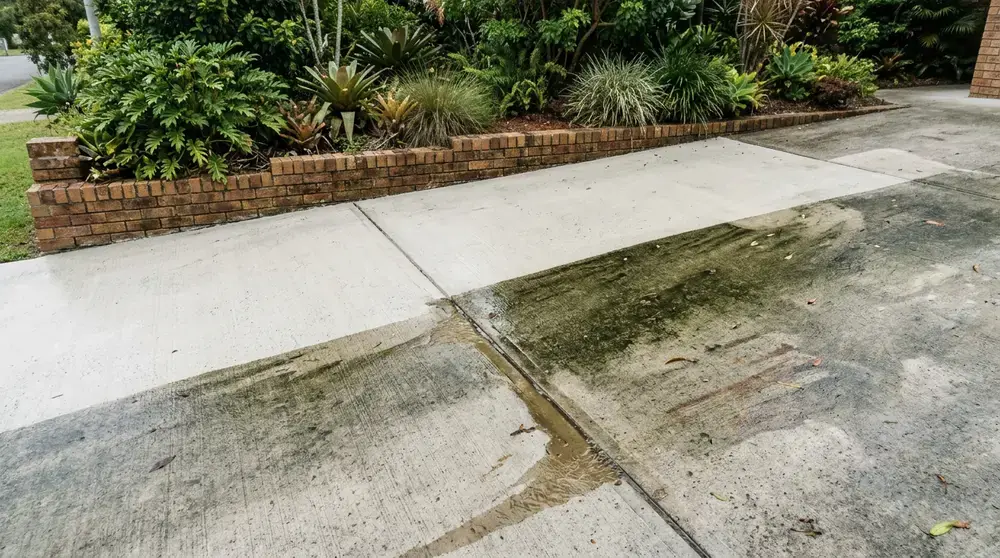
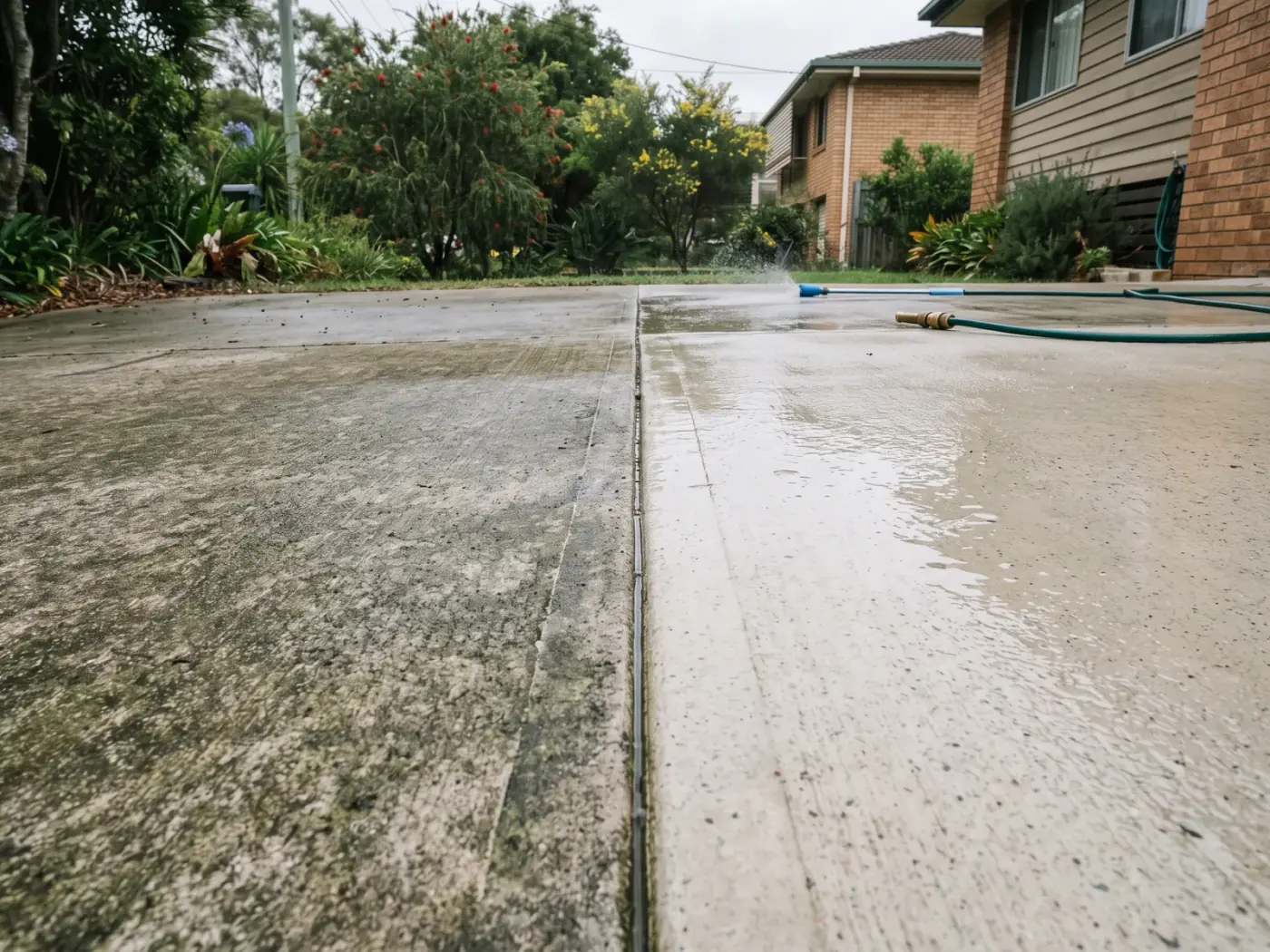
Concrete cleaned evenly, with the stains treated separately
Plain concrete is the most common driveway in Brisbane and the most forgiving to clean. It is porous, which is why it stains, and tough enough to take a proper wash.
The difficulty is evenness. A slab shows every missed pass and every overlap, so the job is as much about method as power.
Stains that a general wash will not shift get treated separately, before the machine goes over them.
Every clean includes
- Slab walked and the staining identified before we start
- Oil, rust and tannin spot-treated with their own chemistry
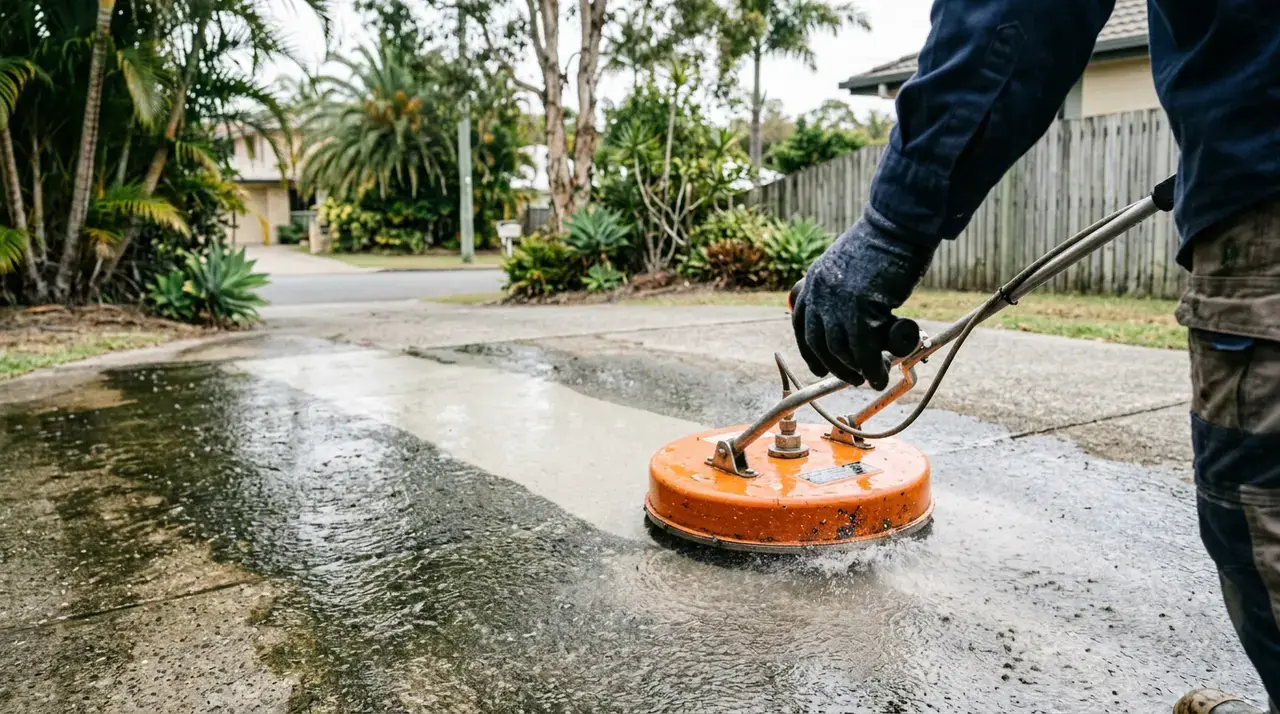
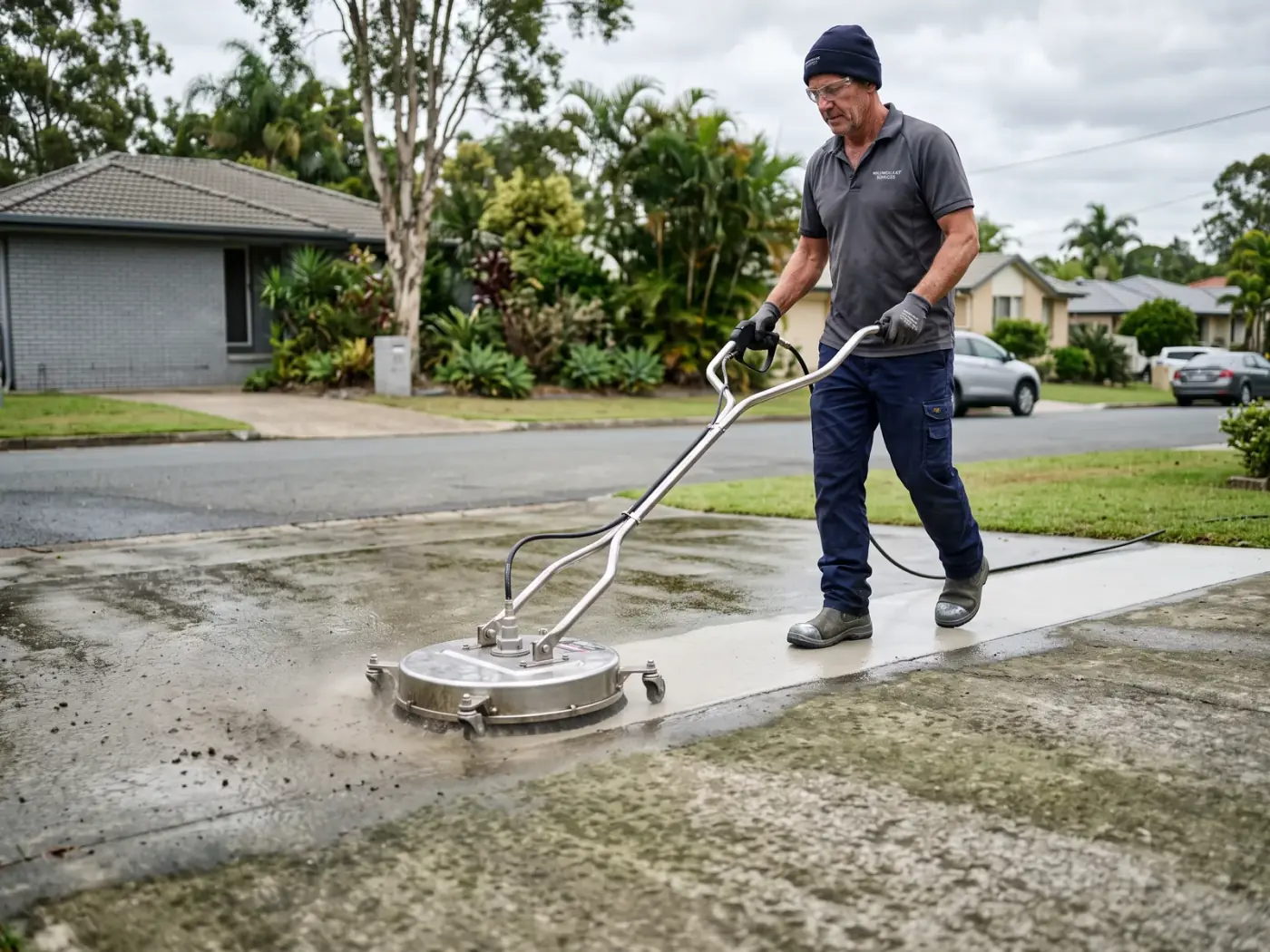
- Rotary surface cleaner run in overlapping passes for an even finish
- Edges, joints and the turn done by wand
- Full rinse so nothing dries back in a ring
- Paths and kerb washed off before we leave
Step by step
The order we work in
- 01
Test square
We wash a small out-of-the-way area to see how the surface reacts before committing to a pressure setting for the whole slab.
- 02
Clear and protect
Cars off, pot plants moved, sensitive plantings checked, and downpipe outlets noted so we know where run-off ends up.
- 03
Pre-treat
The organic growth is treated and left to dwell. Heavy lichen gets a second application rather than a heavier hand on the trigger.
- 04
Spot treatments
Oil, rust and tannin are dealt with individually, each with its own product, dwell time and agitation.
- 05
Surface wash
Overlapping passes with the rotary head at the tested setting, then the wand along edges, expansion joints and the garage lip.
- 06
Rinse and inspect
Everything is flushed so no residue dries back, and we walk the slab with you to look at what came up and what did not.
Why it happens
Why an even finish is harder than it looks
Concrete records everything. A pass held a second too long leaves a bright stripe, and a gap between passes leaves a dull one, both permanent until the next clean.
A rotary surface cleaner solves that by keeping the distance and the speed constant across the slab. A wand alone, waved freehand, is what produces the striped driveways you see around Brisbane.
The wand still matters for edges, joints and corners, where the round head cannot reach. It is the combination that gives an even result.
Don't leave it too long
What we look for on a concrete slab
- Black and green algae wherever the slab stays damp
- Lichen holding tight in flat patches
- Tyre rubber and brake dust in the wheel tracks
- Oil and transmission drips soaked into the pores
- Rust from furniture, reo offcuts or bore water
- Leaf tannin, a warm brown that behaves like a dye
Matched to your surface
Reading the finish before the first pass
Finish
How it behaves
What we change
Broom finished
How it behaves
Holds growth in the ridges, hides minor unevenness
What we change
Standard pressure, slower pass to reach the ridges
Steel trowelled
How it behaves
Smooth, shows any striping immediately
What we change
Wider overlap, consistent head speed
Coloured oxide
How it behaves
Pigment sits in the top few millimetres
What we change
Lower pressure, treatment does more of the work
Stencilled or coated
How it behaves
The pattern is a coating, not the concrete
What we change
Low pressure and chemistry only
Spalling or crazed
How it behaves
Surface is already breaking down
What we change
Gentle wash, and an honest conversation first
We test an out-of-the-way square metre before committing to a setting for the whole slab.
Not all concrete driveways behave the same under a machine. A broom finish has thousands of tiny ridges that hold growth and take a wash well. A steel-trowelled surface is smoother, shows striping far more readily, and needs a wider overlap.
Age matters more than most people expect. A slab poured in the last decade generally has sound cement paste and takes a full-strength clean. A slab from the seventies or eighties may already be losing its surface, and pressure that suits a new pour will pull more sand out of an old one.
Free quote
Get a quote for concrete driveway cleaning
Tell us the surface, roughly how big it is and what has stained it. We'll match the method and give you a clear price before anything is switched on.
- 01
You tell us the surface
Concrete, aggregate or pavers, roughly how big, and what has stained it. A photo helps but is not needed.
- 02
We come back with a price
For the area and the work involved, including anything that needs pre-treating. Nothing starts before you have seen it.
- 03
We book a time that suits
Most driveways are a single visit. You do not need to be home, as long as we can reach a tap and the cars are moved.
Would you rather just talk it through?
(07) 2102 12287:30am - 4:00pm weekdays, 7:30am - 12:00pm weekends.
The full detail, method, surfaces, run-off and aftercare5 sections, open if you want the long version
What a concrete driveway cleaner is actually up against
Concrete is a sponge with a hard face. Water carries whatever is on the surface down into the pores, and once a stain sits below the paste, no amount of pressure at the surface reaches it. That is the difference between a mark that lifts in one pass and one that needs a treatment left to work.
In Brisbane the usual suspects are consistent. Algae across the shaded half, tyre rubber in the wheel tracks, a dark patch where the car sits, tannin under the trees and a rust bloom wherever a steel item has been left out in the rain.
- Black and green algae, the dominant stain on any slab that stays damp
- Lichen, slow growing, tightly attached, wants dwell time rather than force
- Tyre rubber and brake dust, concentrated in the tracks and at the turn
- Oil and transmission drips, the deepest-penetrating stain on the list
- Rust, off garden furniture, reo offcuts, or iron-rich bore water on a sprinkler
- Leaf tannin, a warm brown that reads as dirt but behaves like a dye
- Efflorescence, salts pushing out of the slab as it dries, chalky and white
Old stains are not lost causes
Age makes a stain harder, not impossible. A drip from last month may need a single degreaser pass. The same drip from three summers ago may need the treatment left on, brushed, and repeated. We will tell you which one you have.
Oil, rust and tannin need their own chemistry
The general wash handles the organic layer. Everything else is a separate step, and skipping it is why so many self-washed driveways end up clean but blotchy.
Oil and grease
A degreaser goes on neat, gets agitated with a brush and is left to work before the head passes over it. Deep-set oil often needs a second application, and occasionally a poultice that draws the oil back up as it dries.
Rust
Rust is chemically removed, not blasted off. The acid-based treatment is rinsed thoroughly and kept away from adjacent metal and plants. Bore-water rust spread across a large area can take more than one pass to even out.
Tannin and leaf stain
Tannin off figs, jacarandas and mangoes is a dye rather than a deposit. It responds to different chemistry than algae does, and on a light-coloured slab it usually lifts well.
What an honest concrete driveway cleaner tells you upfront
A clean slab looks different, not new. There are three things we make a point of raising before we start, and they are the same three every time.
- Old oil lightens. A three-year-old drip usually goes from black to a faint grey shadow rather than disappearing altogether.
- Cracks and spalling become more visible once the grime is off. The damage was already there; the dirt was hiding it.
- Colour variation between older and newer parts of a slab, or where a section has been re-poured, stays after cleaning.
The result to expect is an even, consistent slab, not a brand new one. Anyone promising the second is describing a re-pour.
None of that is a reason to leave a driveway dirty. It is the difference between a quote you can rely on and a surprise once the gear is packed away.
The first few weeks after a concrete clean
A freshly washed slab does a few things over the following weeks that catch out anyone who has not had it done before.
It keeps drying for days
Concrete takes on water during a wash and gives it back slowly.
Damp patches lingering where the slab is thicker or permanently shaded are normal, and so is a chalky bloom appearing as the moisture carries salts out with it. Both settle down on their own.
The shaded strip greens up first
Regrowth never arrives evenly across a slab.
The southern edge, the section under a tree and any low spot that puddles will show colour again months before the sunny middle does. That is the same reason those areas were the worst part of the slab before we started.
Marks you never noticed are now obvious
Hairline cracks, an old patch and a re-poured apron all read more clearly against clean concrete. Nothing about the slab has changed except the contrast it is being seen against.
Sealing, and whether your slab needs it
Sealing is not compulsory. A sound, well-drained slab in reasonable sun does fine on a wash every year or two. The case for sealing gets stronger when the concrete is porous, permanently shaded, or sitting under a tree nobody intends to remove.
- A sealed slab sheds oil and tannin instead of drinking them in
- Regrowth slows, because the pores that held moisture are closed off
- The colour deepens slightly, which some people like and some do not
- It has to be redone periodically, and applied to a genuinely clean, dry slab
Never seal over a stain
A sealer locks in whatever is underneath it. If you are planning to seal, the clean has to come first and the slab has to be properly dry, usually a day or more in Brisbane humidity.
More we do
Related driveway cleaning services
Driveway Pressure Washing
Concrete, aggregate and paved driveways washed back to an even colour, with the pressure set to the surface in front of us.
Read moreSealing Preparation
The unglamorous half of a sealing job, cleaned, stripped, spot-treated and properly dry before any coating goes near it.
Read moreExposed Aggregate Cleaning
Aggregate cleaned at a pressure the topping can take, so the stone comes back without the paste holding it being stripped out.
Read more

Where we work
Driveway cleaning right across Brisbane
FAQ
Concrete Driveway Cleaning FAQs
The questions we get asked most about concrete driveway cleaning in Brisbane.
1How do you clean a concrete driveway without leaving stripes?
Stripes come from a narrow tip held too close and moved unevenly. We use a rotary surface cleaner, which encloses two spinning jets and passes the same energy over every part of the slab. Edges are done separately with a wand held at a controlled angle.
2Will cleaning remove oil stains from concrete?
Fresh oil usually comes out completely. Oil that has been soaking in for a year or more lightens considerably but often leaves a faint shadow, because the stain has travelled into the concrete rather than sitting on it. We treat it with degreaser before washing.
3What is the white powdery residue on my concrete?
That is efflorescence, soluble salts carried to the surface as moisture moves out of the slab. It is common on newer concrete and after long wet spells. We can remove the visible bloom, though it may return until the slab has finished drying out.
4Can you clean coloured or stencilled concrete?
Yes, at low pressure. Coloured oxide sits in the top few millimetres and a stencil pattern is a surface coating, so both are cleaned with chemistry and a gentle rinse rather than force. We test a hidden section before touching the whole area.
5Do you need to use my water and power?
We connect to your outside tap and a standard power point, so access to both is all we need. If neither is available, tell us when you book and we will bring what is required. Water use on a residential driveway is modest.
6How soon can I drive on the driveway after cleaning?
Straight away. The slab is only wet, and nothing has been applied to it that needs to cure or set. Sealing is the one exception, a fresh coating needs time before vehicle traffic goes over it, and we will tell you exactly how long on the day.
Still have a question?
Give us a call and we'll give you a straight answer, no obligation.
Get a free driveway quote
Tell us the surface, roughly how big it is and what has stained it. We'll match the method and give you a clear price before anything is switched on.