The short version
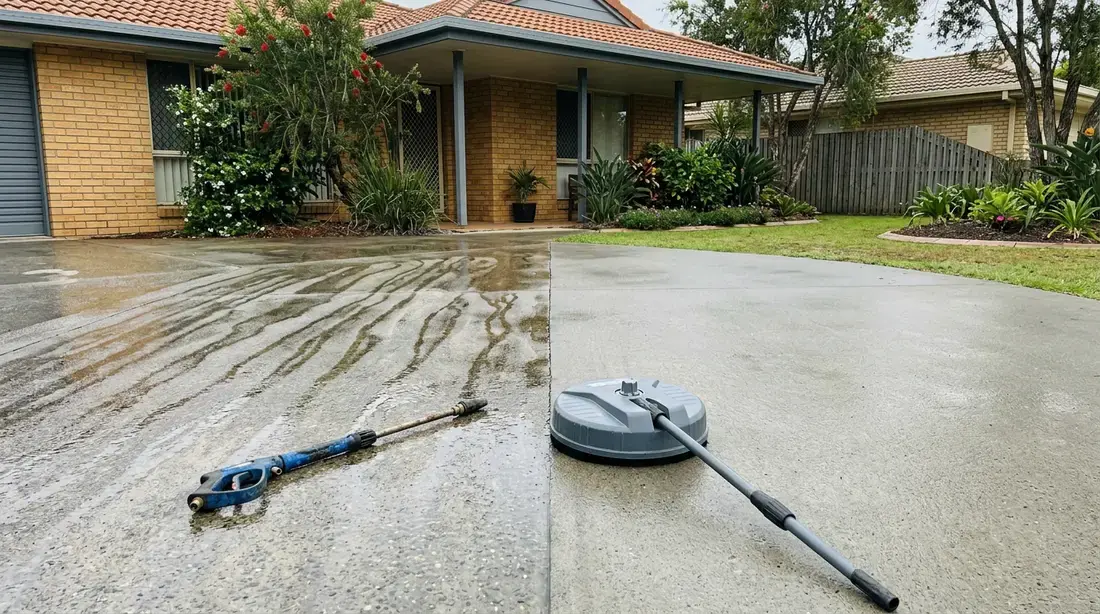
Surface cleaning is not an alternative to pressure washing, it is a rotary attachment that runs off the same pressure washer. The lance or wand concentrates water in a narrow band and suits edges, steps and spot work, while the surface cleaner encloses two spinning jets so every square centimetre of a flat slab gets the same energy. That even distribution is why a surface cleaner produces no stripes on open concrete, and why a proper driveway job uses both, plus a pre-treatment.
Key takeaways
- A surface cleaner is an attachment, not a different kind of machine
- The wand concentrates energy in a narrow band and depends on your technique
- A rotary head passes the same energy over every part of the slab
- Striping is a wand problem, and it is why open concrete gets the rotary head
- Soft washing is the third term people mean: chemistry at low pressure
- A good driveway job uses treatment, a surface cleaner and a wand in sequence
They are not rivals
Surface cleaning is pressure washing. The surface cleaner is a head that bolts onto the same machine in place of the wand, so the question is really which attachment is on the end of the hose.
That trips people up because the two get advertised as though they were competing services. They are two tools that do different parts of the same job, and a driveway generally needs both.
Knowing which is which explains most of what people notice afterwards, particularly why one cleaned driveway is perfectly even and another has lines running down it.
The one-line version
The wand is a narrow, concentrated band of water you steer by hand. The surface cleaner is an enclosed spinning head that treats a wide strip identically as you walk it.
What the wand actually does
A lance holds a single tip that shapes the water into a fan. Change the tip and you change the angle of that fan, which changes how concentrated the energy is when it lands.
A wide fan spreads the force over a broad band and cleans gently. A narrow fan concentrates it, cleans aggressively, and will etch a permanent line into concrete if it is held too close or moved too slowly.
Everything about the result depends on your arm. Distance, angle, speed and overlap are all judged by eye across every pass, which is fine for a few square metres and demanding across a whole driveway.
- Edges, expansion joints and the strip along a garden border
- Steps, landings and the garage lip, where a large head cannot sit flat
- Corners and any area too small for the surface cleaner to fit
- Spot work on stubborn marks after the chemistry has done its part
- Paver joints, cleaned at a controlled angle rather than excavated
What the surface cleaner does
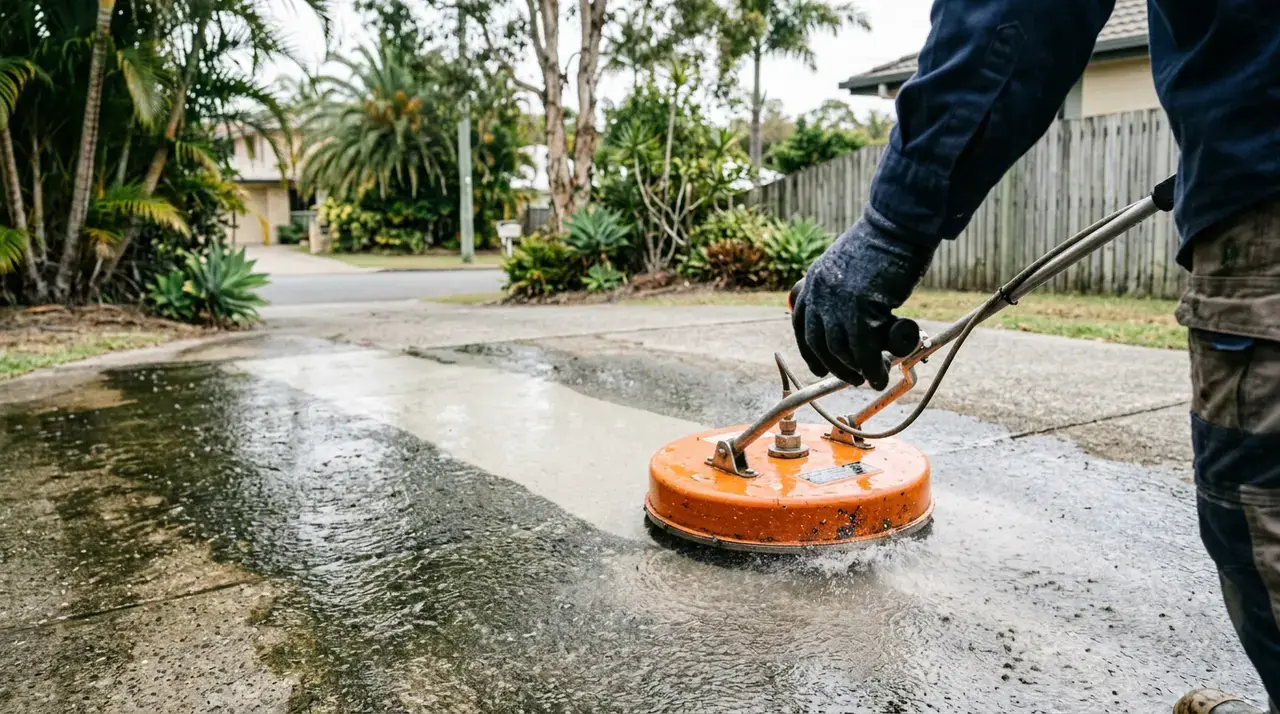
A rotary surface cleaner is a circular housing with a skirt around it and a spinning bar underneath carrying two jets. The bar rotates continuously, so those two jets sweep the entire circle beneath the head.
Because the head is enclosed and always moving, every part of the strip you walk over receives the same energy for the same length of time. That is the whole point of it.
The skirt does a second job by containing the spray. Less water goes onto the garage door, the fence and the car, and the run-off is easier to direct where you want it.
It cannot do everything. The head needs a reasonably flat surface to sit on, so it stops short of edges, will not follow a step, and has to be lifted around obstacles.
Side by side
Wand or lance
Rotary surface cleaner
What it is
Wand or lance
A single tip on the end of the hose
Rotary surface cleaner
An enclosed head with two spinning jets
Coverage
Wand or lance
A narrow band, steered by hand
Rotary surface cleaner
A wide circle, walked in overlapping passes
Evenness
Wand or lance
Depends entirely on technique
Rotary surface cleaner
Consistent by design across the whole strip
Striping risk
Wand or lance
High, especially with a narrow tip
Rotary surface cleaner
Very low on flat concrete
Overspray
Wand or lance
Considerable, walls, doors and cars get wet
Rotary surface cleaner
Contained by the skirt
Speed on open concrete
Wand or lance
Slow, and slower again if you are being careful
Rotary surface cleaner
Much faster, and the pace does not compromise the result
Where it belongs
Wand or lance
Edges, steps, joints, corners, spot work
Rotary surface cleaner
Open flat driveways, paths, patios and car parks
Where it fails
Wand or lance
Large open slabs, if you want them even
Rotary surface cleaner
Anything not flat, and anything it cannot fit into
Two attachments on the same machine, each doing the part the other cannot.
Striping, and why the tool decides it
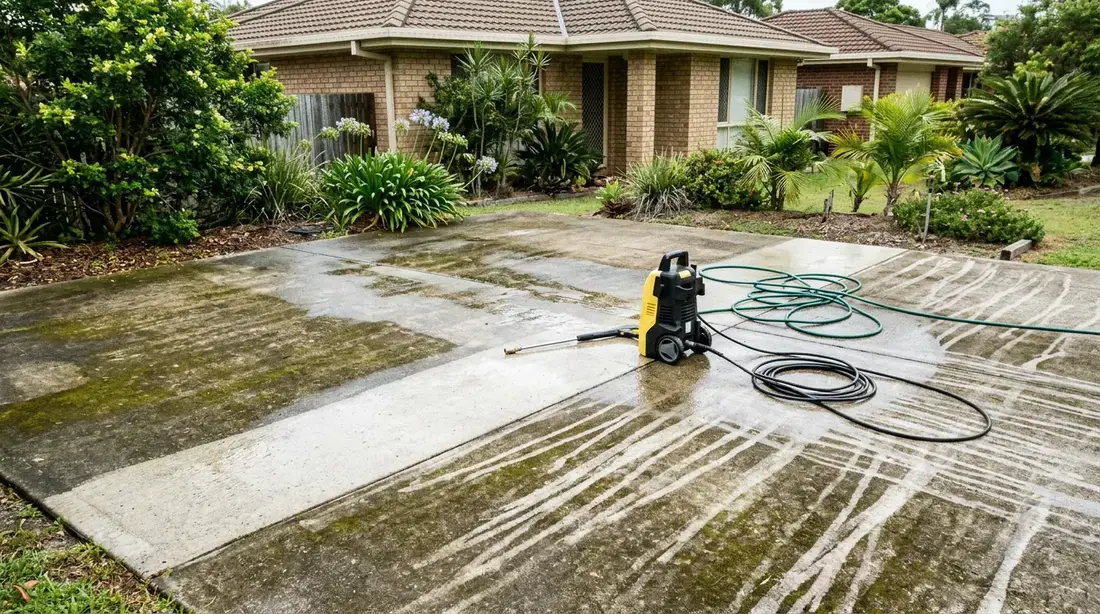
Tiger stripes on a cleaned driveway are the clearest sign of a wand used across an area it should not have been. They are lines where one pass cleaned harder than the pass beside it.
On concrete those lines are not dirt. The harder pass has removed a little more of the cement paste, so the surface itself is now lighter there, and no further cleaning brings the rest up to match.
You cannot wash a stripe out. The only way to lose it is to bring the whole slab down to the same level, which is not a job anyone should want.
Steel-trowelled concrete shows it worst because the smooth surface has nothing to disguise the variation. Broom-finished slabs hide minor unevenness in their ridges, which is why the same technique can look acceptable on one driveway and awful on the next.
The third term: soft washing
Plenty of people asking about surface cleaning are actually asking about soft washing, which is a genuinely different approach rather than a different attachment.
Soft washing applies a cleaning solution at low pressure and lets the chemistry do the removal. Nothing is being blasted off, so it suits surfaces that cannot take mechanical force.
- Pressure washing removes material with mechanical force
- Surface cleaning is pressure washing distributed evenly by a rotary head
- Soft washing removes material with chemistry, at a pressure closer to a garden hose
- Most real driveway jobs are a combination: treat, then wash, then detail
Stencilled and coated concrete is where the soft wash approach stops being optional. The pattern is a coating rather than the slab, and force takes it off.
How a real driveway job uses all of it
On a typical Brisbane driveway the tools come out in a set order, and the order matters more than any one of them.
- 01
Assess and test
Surface type, finish, age and condition, then a small hidden square washed to see how the slab reacts before a pressure is set.
- 02
Pre-treat and dwell
A cleaning solution goes across the whole slab and is left to work, so the growth dies at the base rather than being shaved off the top.
- 03
Spot treatments
Oil, rust and tannin each get their own chemistry and their own dwell, brushed in by hand where they need agitation.
- 04
Surface clean the open areas
The rotary head runs in overlapping passes at the tested pressure, which is what keeps a large slab even rather than striped.
- 05
Detail with the wand
Edges, steps, joints, borders and the garage lip, with a wide fan held at a controlled distance.
- 06
Rinse the lot
A full flush so no residue dries back as a line, with run-off directed away from garden beds and stormwater grates.
The question worth asking a cleaner
Ask whether they use a rotary surface cleaner on flat work and whether they pre-treat before washing. The two answers tell you most of what you need to know about how the driveway will look afterwards and how long it will hold.