The short version
A hired pressure washer is genuinely capable on a small, sound concrete slab with light grime, and for that job the honest answer is often to do it yourself. It falls short on large areas, exposed aggregate, pavers, coloured concrete and heavy or ingrained staining, mostly because domestic units lack the water flow and a rotary surface cleaner needed for even results. The most common DIY damage is striping from a narrow tip and stripped paste or jointing sand, and neither is reversible.
Key takeaways
- On a small, sound, lightly soiled concrete slab, DIY is a fair call
- Water flow matters more than headline pressure, and hire units are short on it
- Without a rotary surface cleaner, even coverage on a large slab is very hard
- Striping from a narrow tip is the most common self-inflicted damage
- Aggregate, pavers and coloured concrete are where DIY goes wrong fastest
- A pre-treatment is what makes a clean last, and it is the step most often skipped
When DIY is the right call
If you have a small, sound plain concrete driveway with light surface grime and no serious staining, hire a machine and do it yourself. That job is well within what a domestic unit and a spare Saturday will handle.
It is a genuinely satisfying piece of work, the result on that kind of slab is close to what anyone else would achieve, and there is no reason to pay someone for it.
The decision gets harder as the slab gets bigger, older, more textured or more stained. That is what the rest of this is about.
The quick sort
Small, flat, plain concrete, lightly dirty: do it yourself. Large, textured, paved, coloured, heavily stained or on a slope: the equipment and the method start to matter more than the effort.
Pressure is not the number that matters
Hire and retail machines are sold on pressure, and pressure is the less important of the two figures. What actually removes material is the combination of pressure and water flow.
Pressure is the force at the tip. Flow is how much water is delivered behind it, and flow is what carries loosened material off the slab and lets you cover ground at a sensible pace.
Domestic units are built around a household tap and deliver far less water per minute than a commercial machine. That is why a hire unit with an impressive number on the box can still take all afternoon on a double driveway.
A high-pressure, low-flow machine encourages exactly the wrong technique: get closer, narrow the tip, go slower. That is how driveways get striped.
A straight comparison
Hire or domestic unit
Professional setup
Water flow
Hire or domestic unit
Limited by a household tap; slow going on large areas
Professional setup
Much higher flow, which is what actually moves material
Main tool
Hire or domestic unit
A lance with interchangeable tips
Professional setup
A rotary surface cleaner for flat work, lance for detail
Evenness
Hire or domestic unit
Depends entirely on your arm; overlap errors show up as stripes
Professional setup
Enclosed head passes the same energy over every square centimetre
Pre-treatment
Hire or domestic unit
Rarely used, so growth is removed rather than killed
Professional setup
Applied and left to dwell so the colony dies at the base
Spot treatments
Hire or domestic unit
Whatever is on the shelf; oil and rust often left as-is
Professional setup
Separate chemistry for oil, rust and tannin, each with its own dwell
Pressure control
Hire or domestic unit
Fixed tips, easy to overdo on a delicate surface
Professional setup
Set after a test patch, and varied across the same driveway
Time on a double driveway
Hire or domestic unit
Most of a day, plus setup and returning the machine
Professional setup
Typically a few hours including treatment and rinse
How long it lasts
Hire or domestic unit
Shorter, because the growth regrows from what was left
Professional setup
Longer, because the pre-treatment did the killing
The gap is mostly flow, tooling and chemistry rather than effort or care.
The striping problem
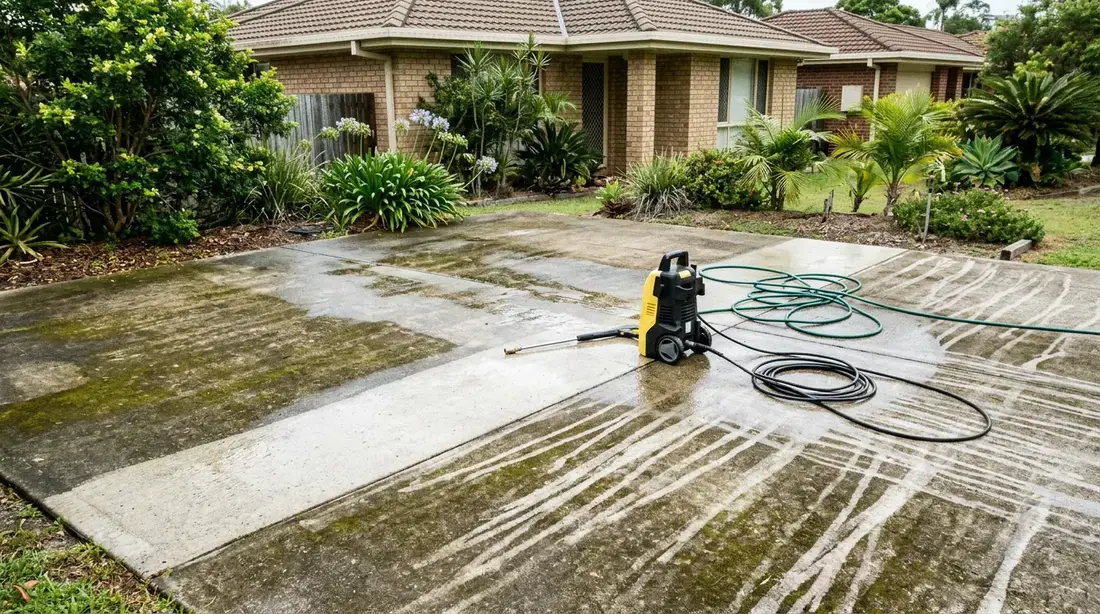
The most common DIY outcome is not a dirty driveway. It is a clean driveway with visible lines across it, and those lines are permanent.
They happen because a lance cleans a narrow band and you have to overlap by eye across dozens of passes. Slow down over one strip, or hold the tip a little closer, and that strip is cleaned harder than the ones beside it.
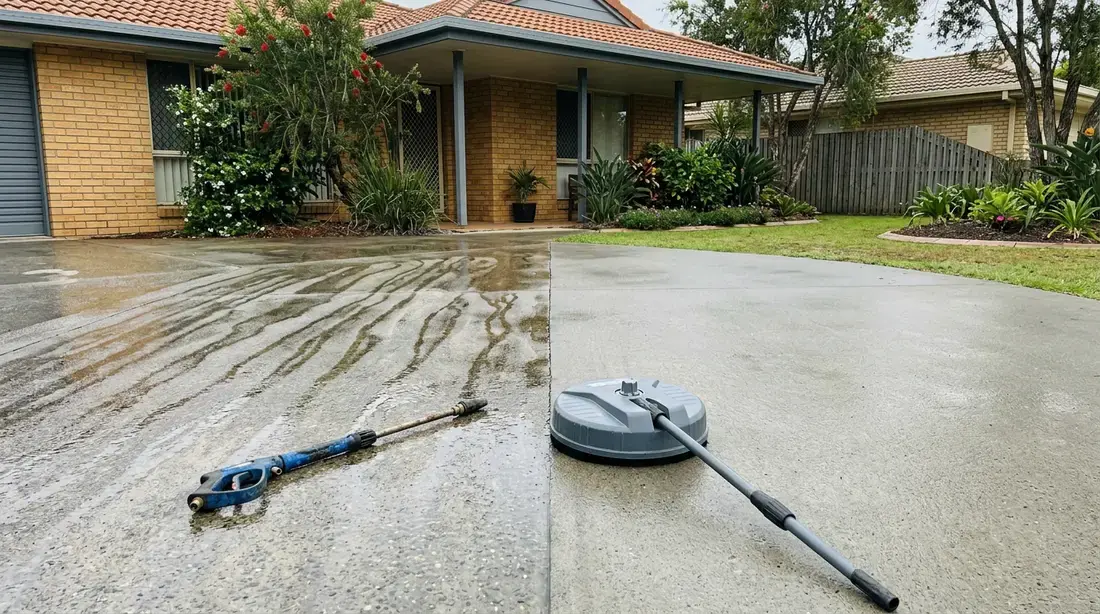
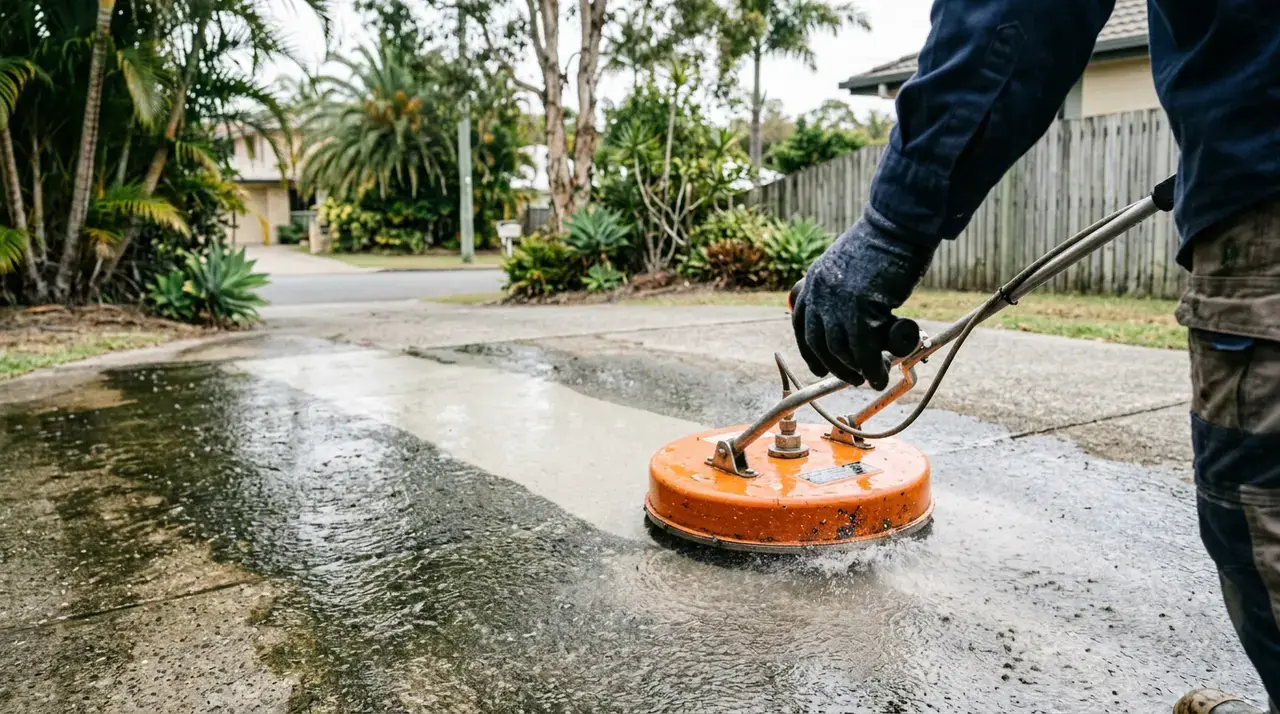
A rotary surface cleaner exists specifically to solve that. It encloses two spinning jets under a skirt, so the energy is distributed evenly and the pass rate is far less sensitive to your technique.
- Keep the tip moving and hold a consistent distance from the slab
- Overlap generously, roughly half the width of your previous pass
- Use the widest fan tip that still cleans, and keep the narrow ones off the driveway
- Never let a turbo or zero-degree tip sit still, even for a second
- Work in a consistent direction so any variation runs with the slab rather than across it
If a surface cleaner attachment is available with the hire unit, take it. On a domestic machine it will run slower than a commercial one, and it still makes the difference between an even slab and a striped one.
Where DIY goes wrong fastest
Some surfaces are unforgiving enough that a single afternoon with the wrong tip creates a repair job. These are the ones to think twice about.
Exposed aggregate
The stones are held by a thin skin of cement paste. Strip that with a turbo tip and pebbles start letting go over the following months, which shows as a pitted patch nothing later will hide.
Pavers
A lance will happily excavate the jointing sand down to the bedding layer. That sand is what locks the units together under vehicle weight, and an empty joint is how a paved driveway starts to rut.
Coloured and stencilled concrete
Oxide colour sits in the top few millimetres and a stencil pattern is a coating rather than the concrete itself. Both are cleaned with chemistry and a gentle rinse, and both are ruined quickly by force.
Older or spalling slabs
A slab from the seventies or eighties may already be losing its surface. Pressure that suits a recent pour will pull more sand out of an old one and leave it looking worse than it started.
If you are doing it yourself, do it in this order
Most of the difference between a good DIY result and a poor one is sequence rather than equipment. This is the order that gets the most out of a hire unit.
- 01
Clear and sweep
Cars off, pots moved, and the slab swept properly. Washing loose leaf matter around wastes water and time.
- 02
Test a hidden square
Pick an out-of-the-way metre near the garage or a side path and see how the surface reacts before you commit to a tip and a distance.
- 03
Pre-treat and wait
Apply a suitable cleaning solution across the whole slab and leave it ten to fifteen minutes so it kills the growth at the base. Mist it on a hot day so it does not dry out mid-dwell.
- 04
Spot-treat the stains
Degreaser brushed into oil, and a separate treatment for rust or tannin. Chemistry first, machine second.
- 05
Wash in overlapping passes
Widest effective tip, consistent distance, half-width overlap, one direction. Do the whole driveway in a session rather than half now and half next weekend.
- 06
Rinse everything down
Flush the whole area so nothing dries back as a residue line, and direct run-off onto grass rather than into a stormwater grate.
Treat the lance with respect
A pressure washer at close range will cut skin, and it will do it before you feel it. Wear closed shoes and eye protection, keep the trigger away from feet and pets, and keep the machine and its leads clear of standing water.
How to decide, in one paragraph
Look at the surface, the size and the staining. Plain sound concrete, a modest area, light green film and no oil is a DIY job, and doing it yourself is the sensible answer.
Exposed aggregate, pavers, coloured concrete, a large or sloped slab, heavy lichen or old oil is where the tooling and the chemistry start to determine the outcome rather than the effort. That is when driveway pressure washing done properly is worth the call.
There is also a middle road that suits plenty of homes. Do the light maintenance washes yourself, and bring someone in when the slab needs a full treated clean, sealing preparation, or a stain dealt with that you have already had two goes at.