The short version
Most Brisbane driveways need pressure cleaning once a year, and every six months where the slab is shaded, sits under trees, carries heavy traffic or is close to the bay. The wet season from November to March is what sets the pace, so cleaning before it starts makes each wash last noticeably longer. Sealing a porous slab every two to three years stretches the interval further again.
Key takeaways
- Once a year is the right interval for most Brisbane driveways in reasonable sun
- Shaded, tree-covered, bayside and high-traffic slabs do better on six months
- The wet season from November to March is what starts the clock each year
- Clean before the wet, not after, so growth has less time to establish
- Sealing a porous slab every two to three years slows the regrowth cycle
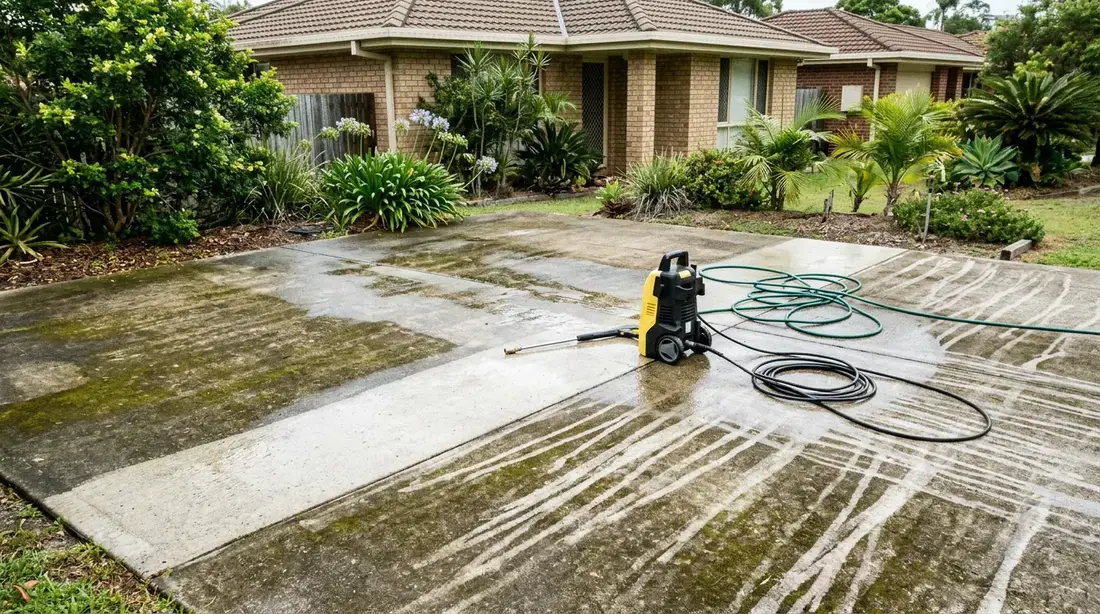
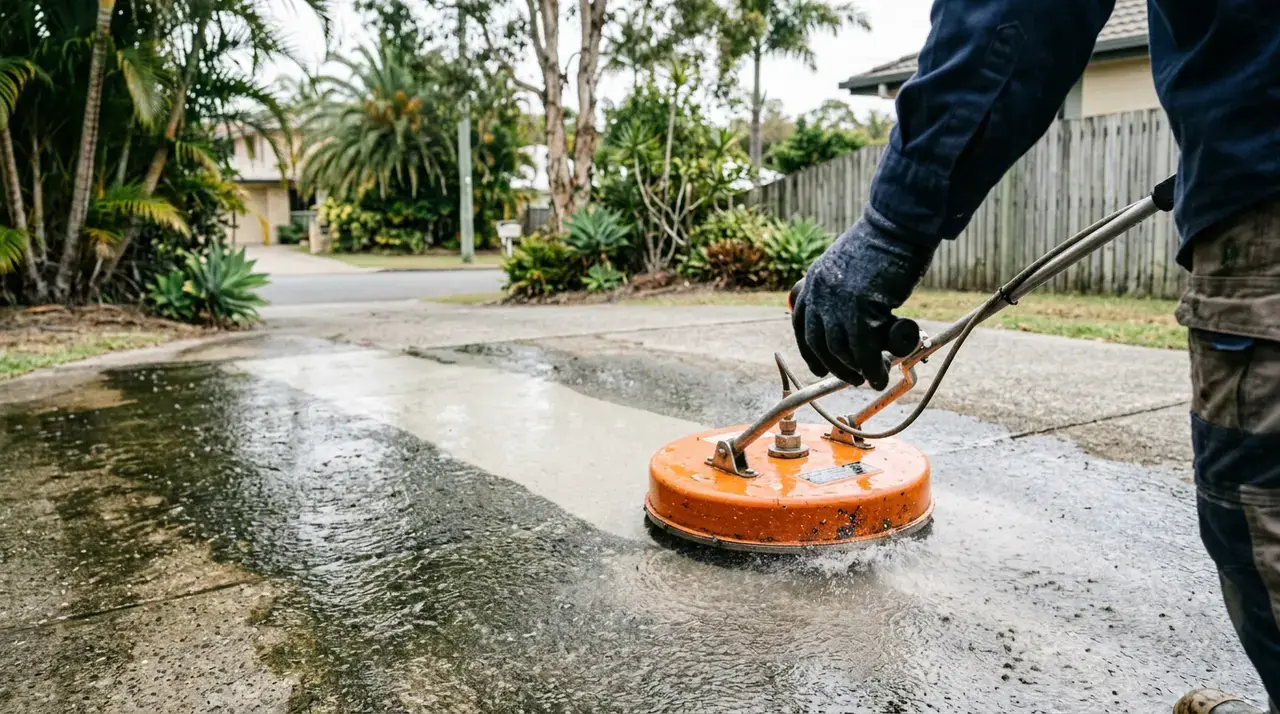
- Use the lowest pressure that works, with a rotary surface cleaner on flat areas
How often is often enough?
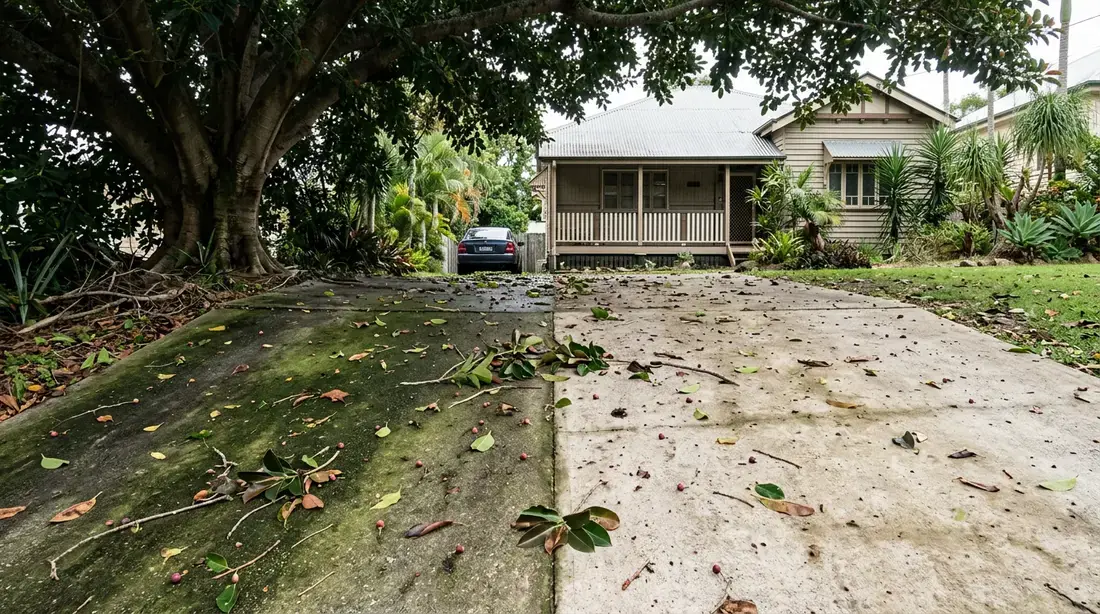
Once a year is the right interval for most Brisbane driveways. Every six months is the right interval if your slab sits in shade, has trees over it, carries a lot of traffic, or is close to the water at Wynnum, Manly or Lota.
For a good number of homes that is the end of the decision. The rest of this page is about working out which of those two groups your driveway belongs to, and why the gap between them is so wide.
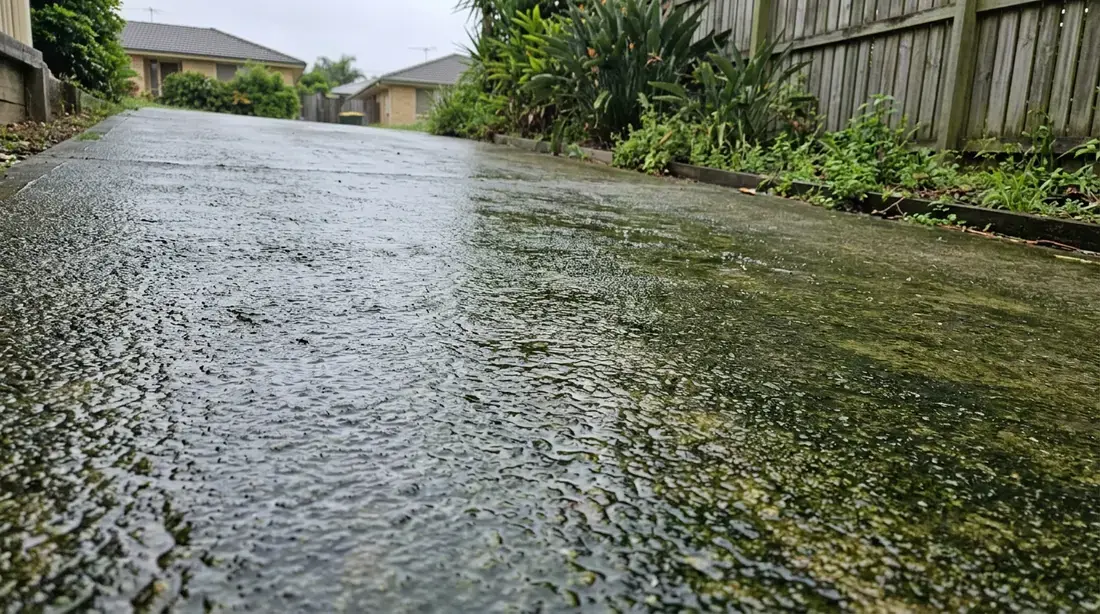
The deciding factor is not the concrete itself. It is how long the surface stays damp after it rains, because that is the one condition algae cannot do without.
1 year
Interval that suits most Brisbane driveways
6 months
Shaded, tree-covered or bayside slabs
Nov to Mar
The wet season that sets the pace
2-3 years
How often a sealed slab is usually recoated
The signs your driveway is already telling you
You do not need a calendar reminder if you know what to look at. A driveway announces that it is due well before it looks properly dirty.
- A green or grey tinge appearing along the shaded edge, usually the southern boundary or the side against the house
- The surface feeling slick underfoot in the morning while it is still damp with dew
- Dark wheel tracks that stay dark after rain instead of drying back to the colour of the rest of the slab
- Black speckling on the concrete that a broom will not shift
- Pale crusty rosettes of lichen, which are slow to arrive and slow to remove
- Water sitting in a low spot for a day or more after a storm
The slip is the one to take seriously. A film of algae on wet concrete is far more slippery than the concrete underneath it, and it is at its worst on a sloped driveway on a wet winter morning.
Slip risk is the real deadline
If the driveway is slick when it is wet, it is overdue regardless of how it looks. That is the point where the cleaning interval stops being a cosmetic question.
What puts a driveway on the six-month cycle
Two identical slabs on the same street can need cleaning at completely different intervals. What separates them is sun, trees, traffic and salt, in roughly that order.
Situation
Why it speeds things up
Interval to aim for
Full sun, good fall, no trees
Why it speeds things up
The slab dries within an hour of rain stopping
Interval to aim for
Every 12 to 24 months
South-facing or shaded by the house
Why it speeds things up
Little or no direct sun between May and August
Interval to aim for
Every 6 to 12 months
Under a fig, jacaranda or mango
Why it speeds things up
Constant leaf drop, tannin staining and permanent damp
Interval to aim for
Every 6 months
Bayside, within sight of the water
Why it speeds things up
Salt film holds dust and feeds the same growth
Interval to aim for
Every 6 to 12 months
Two or more cars, in and out daily
Why it speeds things up
Rubber, brake dust and drips build up in the tracks
Interval to aim for
Every 6 to 12 months
Shared strata or commercial driveway
Why it speeds things up
Traffic volume no home slab comes close to
Interval to aim for
Every 6 to 12 months
Starting points, not rules. A slab that ticks two of these boxes moves to the shorter interval.
Surface matters too, though less than people expect. Exposed aggregate and pavers hold organic matter down in their texture and joints, so they often look tired sooner than a smooth slab in the same position.
The best time of year to book it in Brisbane
Clean before the wet season rather than after it. A slab washed in August or September goes into the heavy rain months with nothing established on it, so the growth has to start from scratch.
Cleaning in March does the same amount of work but buys you less. By then the algae has already had its best growing conditions of the year and the next favourable stretch is months away.
Winter also happens to be the practical window. Humidity is lower, slabs dry faster, and if sealing is part of the plan the drying step stops being the hardest part of the job.
Aim for late winter
August and September give you a dry slab, a quick turnaround, and a full clean run into the storm season. It is the single easiest change you can make to how long a wash lasts.
You can also clean a driveway too often
Concrete is not infinitely renewable. Every wash takes a little of the cement paste with it, and a slab put through a hard clean every few months ages faster than one washed annually.
The damage rarely comes from the schedule on its own. It comes from the combination of frequent washing and too much pressure, usually a narrow tip held close to the surface.
- Use the lowest pressure that actually removes the growth, not the highest the machine will produce
- Let a pre-treatment sit and kill the growth at its base rather than shaving the top off with force
- Run a rotary surface cleaner on flat areas so every square centimetre gets the same energy
- Keep a zero-degree or turbo tip away from exposed aggregate, pavers and coloured concrete
- Test a small out-of-the-way square before committing to a setting for the whole slab
A driveway washed gently once a year will outlast the same driveway blasted every three months, and it will look better in between.
Sealing stretches the interval
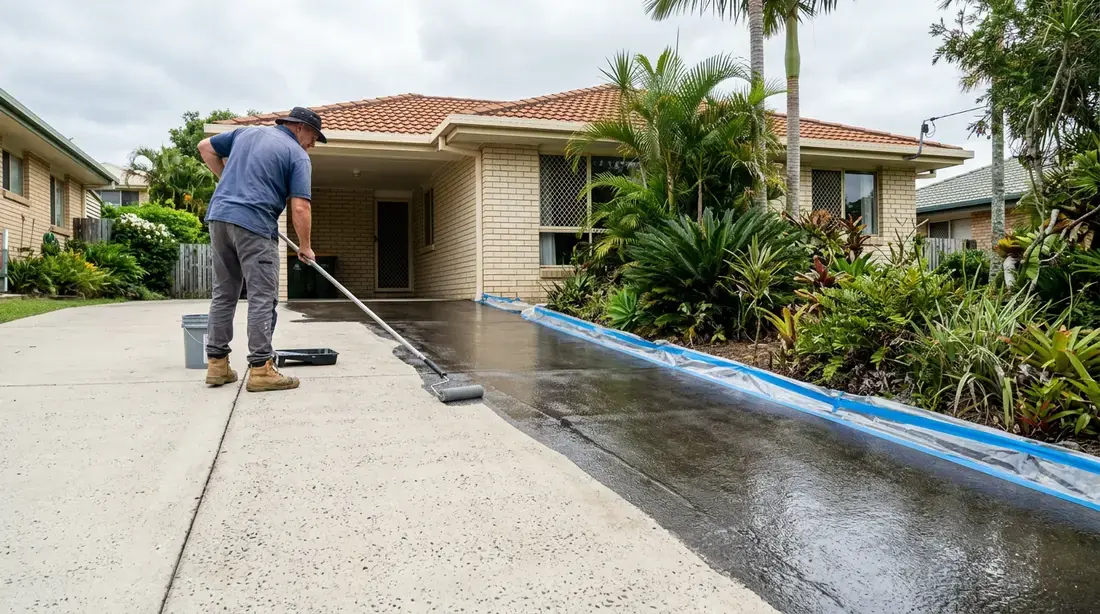
Sealing is the main lever available if you are tired of the cycle. A sealed slab sheds oil and tannin instead of drinking them in, and the pores that used to hold moisture are closed off.
A coating on a driveway generally needs redoing every two to three years in this climate, sooner where the sun is direct and the traffic is heavy. That is the trade you are making: a recoat every few years instead of a heavy clean twice a year.
- Sealing is most worthwhile on porous concrete, permanently shaded slabs, and anything under a tree that is staying put
- It is usually unnecessary on a full-sun driveway with good drainage and nothing overhanging
- The slab has to be genuinely clean and properly dry first, which is what driveway sealing preparation is for
- A sealer locks in whatever is beneath it, so a stain left on the concrete becomes permanent
If sealing is not for you, the honest alternative is the annual wash. There is nothing wrong with that, and for most Brisbane driveways it is the simpler arrangement.
What to do in between
Most of the difference between a driveway that lasts eighteen months and one that greens up in six is upkeep that takes minutes rather than money.
- 01
Sweep after leaf drop
A wet leaf mat is where growth starts. Ten minutes with a yard broom in autumn removes the material algae would otherwise colonise over the wet season.
- 02
Lift what is overhanging
Even a modest amount of extra morning sun slows regrowth. Trimming the lower branches over the slab does more than any product you can buy.
- 03
Chase the water
Check where downpipes discharge and whether a garden bed is washing soil across the concrete after every storm. Constant water in one spot is why that spot always greens first.
- 04
Rinse drips early
Fresh oil comes up far more easily than oil that has sat through a Brisbane summer. A quick degrease the week it happens saves a treatment later.
- 05
Book before you need to
Light regular cleans are quicker than one heavy clean after years of build-up, because nothing has had time to become ingrained.
None of that replaces the wash. It just decides whether the next one is a straightforward pass or a job that needs repeat treatments on lichen.