The short version
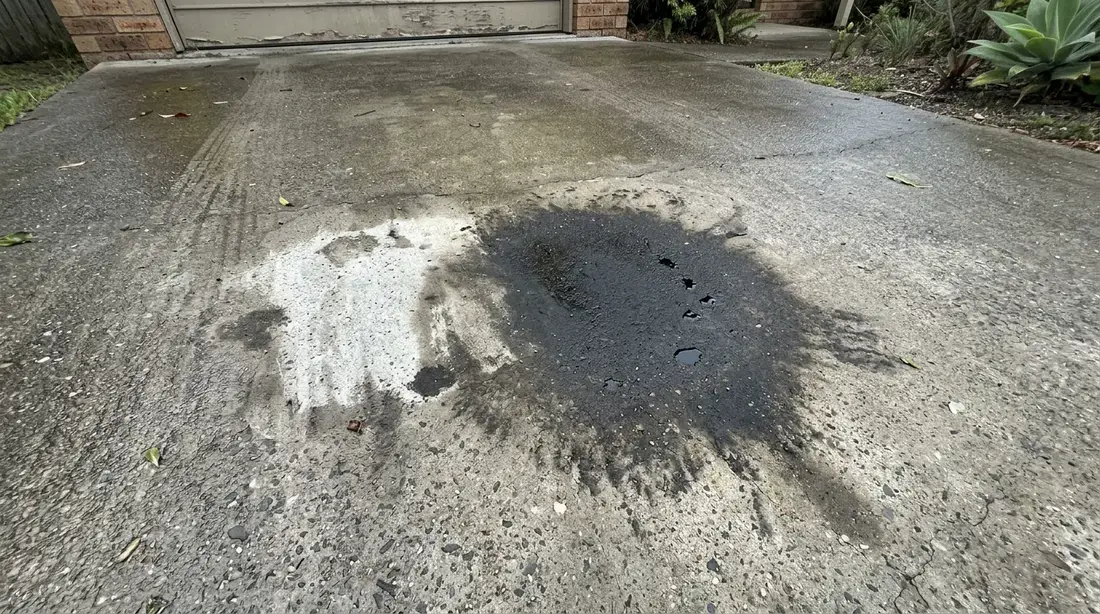
Fresh oil on concrete is removed by soaking it up with an absorbent first, then scrubbing a degreaser into the surface and rinsing. Oil that has been sitting for months or years has travelled into the concrete rather than onto it, so it lightens considerably but often leaves a faint shadow, a poultice is the best tool for those. The most useful rule is that speed beats strength: a spill dealt with the same week comes out far more easily than the same spill after a Brisbane summer.
Key takeaways
- Soak fresh oil up with an absorbent before you put any water near it
- Degreaser needs agitation and dwell time, not pressure, to do its work
- Old oil sits inside the concrete, so expect lightening rather than disappearance
- A poultice draws deep oil back up as it dries and is worth the wait
- Never use petrol or solvents on a driveway, and never mix cleaning products
- Direct the rinse away from stormwater drains and garden beds
The short version
Fresh oil comes off concrete: cover it with an absorbent, sweep that up, then scrub a degreaser into the surface and rinse. Old oil that has soaked in will lighten a long way but often leaves a faint shadow, because the stain is inside the slab rather than on top of it.
That distinction drives everything else here. A drip from last weekend is a fifteen-minute job with a brush, while a patch that has sat under a parked car for three summers is a repeat treatment and, sometimes, a poultice.
Neither is a job for high pressure on its own. Pressure removes what is on the surface, and oil is the one common driveway stain that is not.
Speed beats strength
Almost nothing improves your odds more than acting the same week. Oil migrates deeper into concrete with every hot day, and warm slabs move it faster than cool ones.
Why concrete holds onto oil
Concrete looks solid and behaves like a sponge with a hard face. The cement paste on the surface is full of tiny pores, and anything liquid sitting on it is slowly drawn down into them.
Water evaporates back out again. Oil does not, so it stays where it settled and darkens the slab from within.
Heat makes it worse. On a Brisbane driveway in January the slab gets hot enough to thin the oil, which lets it travel further down.
An unsealed slab therefore stains far more readily than a sealed one, where a drip sits on the coating and wipes away. That is part of the argument for sealing a driveway you park on daily.
Fresh spills: the first hour matters
If the oil is still wet, do not reach for the hose. Water spreads a fresh spill outward and pushes it down at the same time, turning a small dark circle into a large pale one.
- 01
Cover it with an absorbent
Cheap clay cat litter, sawdust, sand or a proprietary absorbent granule all work. Pile it on generously so the whole spill is buried rather than dusted.
- 02
Grind it in and wait
Crush the granules underfoot so they break down and make contact with the concrete. Leave it for a few hours, or overnight if the spill was heavy.
- 03
Sweep up and bin it
Sweep the saturated absorbent into a bag rather than hosing it across the slab or into a garden bed. It is now oily waste, not driveway dust.
- 04
Degrease what is left
Apply a concrete degreaser neat to the shadow, work it in with a stiff-bristled brush, and let it sit for the time on the label rather than rinsing straight away.
- 05
Rinse and reassess
Flush the area thoroughly and let it dry before judging the result. Wet concrete looks darker than it is, so a stain that seems to remain often is not there once dry.
A fresh spill handled this way usually leaves nothing at all. Repeat the degreaser step once if a faint mark survives the first pass.
Older stains: chemistry, agitation, patience
For a stain months old the process is the same, but the repetition is the point. One application of degreaser on a three-year-old patch will barely register.
Wet the slab first
Dampening the concrete before the degreaser goes down stops the product being sucked straight into dry pores away from the stain. It keeps the chemistry where you want it.
Apply neat, agitate properly
Put the degreaser on undiluted and work it in with a stiff brush in both directions. Agitation matters more than most people expect, because it is what gets the product into the surface rather than sitting on it.
Give it dwell time
Let it work for as long as the product allows without drying out. On a hot day mist the area lightly so the degreaser stays wet through its dwell instead of baking off in ten minutes.
Rinse, dry, repeat
Rinse thoroughly, let the slab dry completely, then look again in daylight. Two or three cycles get an old stain to its realistic best.
The poultice, for oil that has gone deep
A poultice is the one method that pulls oil back up out of concrete rather than attacking it from above. It is slow, it looks unglamorous, and it is the most effective thing available for a deep stain.
The principle is simple. A degreaser is mixed with an absorbent powder into a paste and spread over the stain; as it dries it draws the dissolved oil out of the pores and into itself.
- Mix an absorbent powder with a suitable degreaser into a paste about the consistency of thick cream
- Spread it over the stain roughly a centimetre thick and a little wider than the mark itself
- Cover with plastic taped at the edges for the first day so it does not dry too quickly
- Remove the plastic and let the poultice dry out completely, which usually takes another day or two
- Scrape it up, bin it as oily waste, and wash the area down
- Repeat if the stain has lightened but not finished lightening, this often takes two or three rounds
Test any poultice on an out-of-the-way patch first, particularly on coloured or stencilled concrete. Some combinations will lighten a pigmented surface, and that is not reversible.
What not to do
Most permanent driveway damage comes from an attempt to remove a stain rather than from the stain itself. A few things are worth ruling out before you start.
Never use petrol or paint thinners on a driveway
They will move the oil around, they are a fire and vapour hazard on an open slab, and they wash into stormwater. There is no result they achieve that a proper degreaser and a poultice will not.
- Do not mix products. Acid-based rust removers and chlorine-based cleaners together produce a genuinely dangerous gas.
- Do not hold a narrow or turbo tip on one spot to blast a stain out. You will etch a permanent light patch into the slab that is more obvious than the oil was.
- Do not use a wire brush on a soft or older slab, because it pulls sand out of the surface and leaves its own mark.
- Do not let oily rinse water run into a stormwater grate. Direct it onto grass or a garden bed away from the drain, or contain it.
- Do not seal over an oil stain. The mark is locked in permanently and the sealer will not bond to the contaminated area anyway.
Wear eye protection and gloves for any of the chemistry described here, and keep degreaser off adjacent plants and paintwork.
What a realistic result looks like
A fresh spill goes away. A stain from last year lightens to a faint grey shadow that most people stop noticing once the rest of the slab is clean.
A patch where a car has dripped in the same spot for a decade will improve, and it will still be visible. The oil has travelled below the depth any surface treatment reaches, and no amount of pressure changes that.
The most useful thing anyone can tell you about an old oil stain is that it will lighten. Anybody promising it will disappear is describing a slab they have not seen.
There is a second reason to clean the whole driveway rather than just the stain. An oil shadow reads as a blemish on grimy concrete and almost vanishes on an evenly cleaned slab, so a full concrete driveway clean often does more than another round of degreaser.
Deal with it before you seal
If sealing is on the plan, get the oil out first and give the slab a proper dry. Sealing preparation exists because a coating locks in whatever was underneath it.